

Why The Listed Price Of A Costco Membership Isn't Always What You Pay
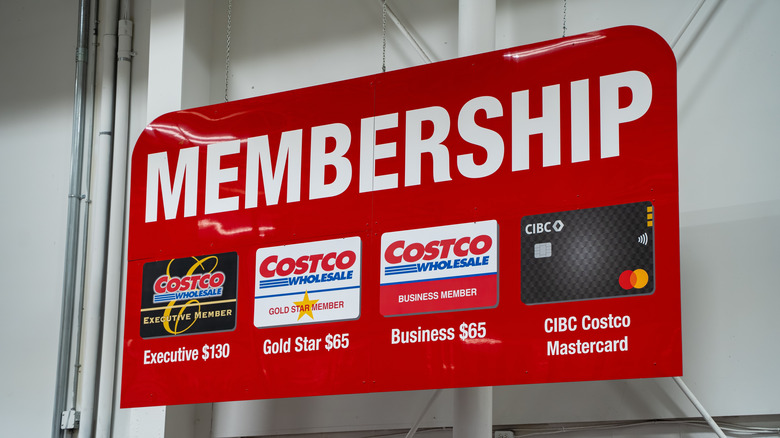
Devoted Costco shoppers will tell you that dishing out an annual membership fee ($65 for the basic Gold Star or $130 for the Executive membership) is fully worth it, for must-have products under $5 and other great deals. That's why the store has a high retention rate. However, when you check your credit card statement, you might be surprised that you have been charged more due to sales taxes.
Whether Costco charges a sales tax on membership and how high it is depends on the state. Some states charge sales taxes for wholesale club memberships like Costco. Because the membership gives you access to goods that fall under the sales tax, it is taxed at the same rate. In addition, 38 states also let cities, counties, or districts levy a local sales tax. By law, Costco is required to add both taxes to the membership fee, as applicable. Depending on where you live, this may end up being a pretty penny. For example, in Louisiana, where wholesale club memberships like Sam's Club and Costco are taxed both by the state and locally, the combined tax rate is 10.11% (the highest in the country), so you may end up paying $143.14 for an Executive Membership every year.
While this may not deter you from becoming a Costco member or renewing your membership, to gauge the total cost of a membership, the fine print on the webpage with the membership benefits reads, "plus applicable sales tax," so you'll need to do the legwork. To calculate exactly how much will be added, look at your state tax rate and, if there is one in the place where the warehouse is located, also the local sales tax.
Why certain food items fall under the sales tax
The sales tax for a wholesale club membership is location-based, so it's pretty straightforward. The same applies to dining; whether you eat at a restaurant or get takeout, you are being charged the standard sales tax — no surprises here. But looking at your Costco receipt, you may wonder why some grocery items are being taxed, and others aren't. In most states, there is no sales tax on basic foods, including bread, meat, dairy, and produce.
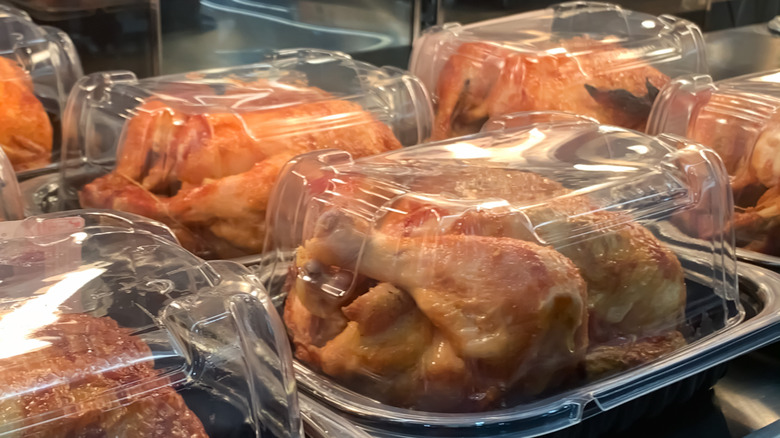
However, if you buy a frozen dinner at the supermarket, you will be charged sales tax because taxable food includes anything that has been handled or prepared. That solves the mystery as to why there is no sales tax on raw chicken breasts, but there is for grocery stores' rotisserie chickens. Generally, any food that is ready to eat, hot or cold, and may come with utensils is charged a sales tax. The difference between taxable ready-to-eat and non-taxable items can be confounding. In Pennsylvania, cookies that you buy at an "eating establishment" are taxable, but if you buy cookies at a grocery store, you don't have to pay taxes on them.
Additionally, some U.S. cities charge a soda tax, which includes any beverage sweetened by sugar. Unlike other taxes, this is not a percentage of the sale price but a charge of 1 to 2 cents per ounce. The purpose of this tax is not just to put money in the state's coffers but to discourage people from consuming too much of the stuff — and it's been successful. Areas with a soda tax have seen declining sales.