

What Makes German Chocolate So Special?
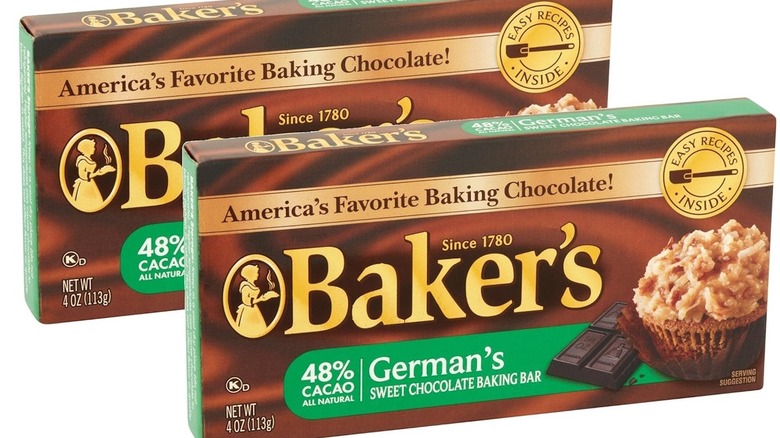
Just like German chocolate cake, German chocolate isn't what it sounds like. It doesn't come from Europe, much less Deutschland, but from America, where it was created as an easy-to-use ingredient for bakers.
Technically, it's actually called German's chocolate — though it was once referred to as "German chocolate," and many folks still omit the possessive — since it was developed by Samuel German in 1852. Most baking types contain a ton of cacao but very little sugar, since it's assumed that cooks can just add more later. For example, both bittersweet and semisweet must contain at least 35% cacao, but the former can contain as much as 91%, and the latter maxes out around 60%. German chocolate, however, is 48% cacao, with extra sugar to skip the step of sweetening batters, and less cocoa butter. It still has all the hallmarks of high-quality chocolate, like a good snap, a smooth surface, and a short ingredient list, but it straddles the line between baking and eating kinds.
Unlike broader categorizations, German chocolate is a single product owned by Baker's Chocolate, which was later sold to The Kraft Heinz Company. This means you'll encounter very little variation in its recipe, unless the box specifically says otherwise. So, when a recipe calls for a set amount of German chocolate, you don't have to worry about adjusting your measurements to account for varying levels of cacao, cocoa butter, or sugar. Unless you find regular baking varieties with the exact ratios and percentages listed in the recipe, you might have a bit of math in your future.
Mild flavor and predictability make German chocolate ideal for experimenting
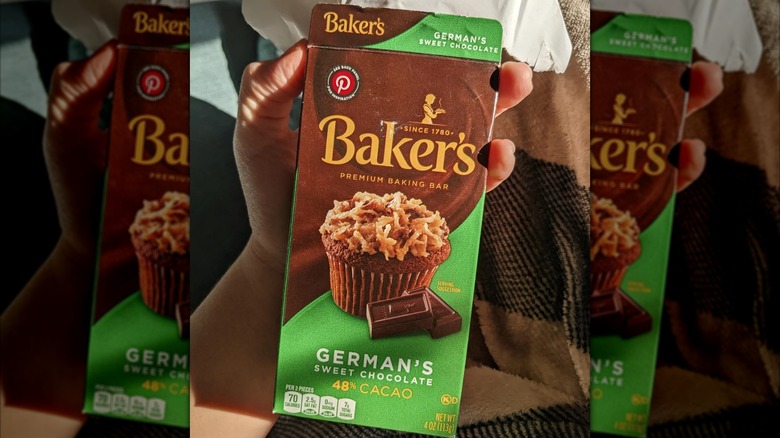
German chocolate has a fairly mild, unobtrusive flavor, and behaves much like other types when exposed to heat. Factor in its pre-sweetened state, and it's a great choice when you're looking to make something quick and easy.
While most baking varieties are dairy-free, some still use milk-based ingredients. German chocolate, however, is generally more reliable, using soy lecithin as an emulsifier to reduce viscosity and help the chocolate flow smoothly. However, while you won't find dairy on its ingredient list, its packaging does disclose that it may contain milk. This usually means that the product carries some risk of cross-contamination, whether it's manufactured on the same equipment as dairy chocolate or just made in the same facility. Still, it's an excellent pick for those preferring plant-based treats, whether for snacking or for whipping up a dessert.
Between its predictability and affordability, German chocolate is a solid choice when you're experimenting. Rather than using up an expensive, highly flavorful bar, it gives your recipes the chance to let other flavors come to the fore. This is especially important the more unconventional you get, like using soda or wine to revamp classic chocolate cake, because you'll want to know exactly how those ingredients interact with one another. It's an especially useful tool for balancing the acidity of things like citrus fruits, as its added sugar helps tone things down without eliminating them entirely.
Typical baking chocolate has more flexibility and variation
While German's chocolate is a reliably middle-of-the-road option for bakers, regular, more abundant types give them the range of choice they need to achieve specific flavors in their recipes. The term "baking chocolate" is so broad that it presents both opportunities and hurdles; while you may struggle to find a variety with exact ratios and percentages, it is easy to achieve a specific flavor once you do. Conversely, if you didn't care for a recipe the first time, swapping to a different type makes adjusting the taste simple.
While the sweetened German variety may be good for experimenting with recipe additions, its sheer consistency removes any chance of playing with the chocolate itself. So, the more chocolate-focused the recipe is, the more useful other forms become, as their generally lower sugar levels give you the flexibility to dial in the sweetness much more precisely.
These more common varieties also allow you to use different sweeteners in larger amounts. While German chocolate provides enough sugar that you'll have to reduce other sweeteners, a bittersweet variety provides tons of chocolate flavor while still leaving room for another ingredient to steal the spotlight. For instance, if you're making something where honey is a powerful flavor, German chocolate will only allow you to use so much before your dish becomes sickeningly sweet, reducing the honey's presence.