

How The Original Donut From America's First Shop In 1673 Was Different From Today's Version
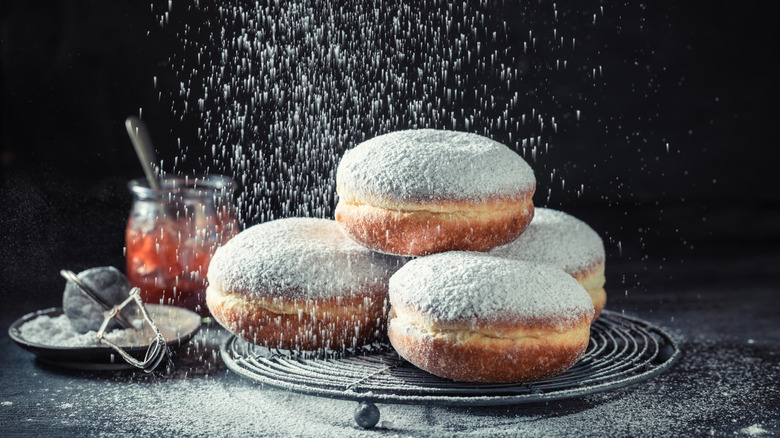
Whenever you're having a bad morning, there is nothing like a good donut to dissipate all your frustrations. And these days, the options are, to put it simply, plentiful. It seems that every good-sized city, and even some small towns, have a terrific donut option (some with regional varieties, like the Persian donuts of Thunder Bay, Ontario). And if you don't have a homemade donut spot, you likely at least have a Dunkin' (which used to make its own cereal in the 80s). But none of this morning uplift would be possible without the first donut shop in the U.S., which paved the way for thousands to come. It was opened all the way back in the 17th century in New York City by a woman of Dutch origin named Anna Joralemon. However, her donuts differed significantly from the ones we recognize today; it seems they didn't have a hole in the middle.
Called olykoeks, or "oily cakes" these early donuts were actually prepared in much the same way that they are today; that is, they consisted of dough that was fried (in animal fat) until golden. However, they were flat like discs, and instead of a glaze of icing with sprinkles or an injection of fruit goo, they often featured sweet bits of dried fruit, warm spices, nuts, or a coating of sugar.
Donut hole lore: How donuts got their round cut-outs
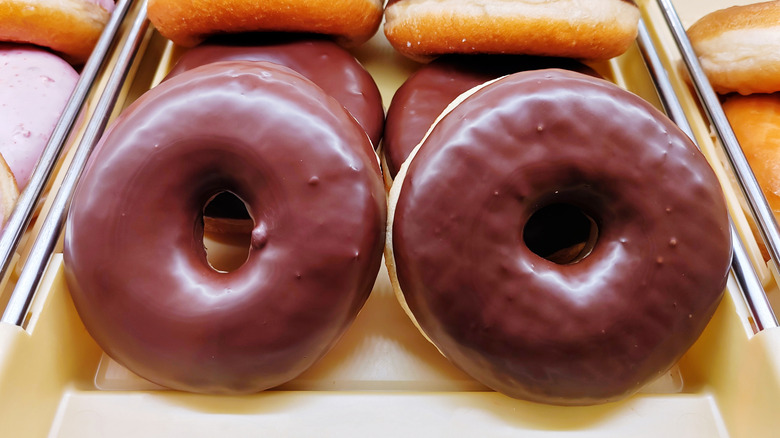
Donuts continued in this non-holey fashion for nearly 200 years. But there is a story concerning one Elizabeth Gregory and her son Hanson, who lived in the 1800s, which might explain how those round punctures came to be (this time period was awash in culinary discoveries, like the invention of the brownie). Hanson was a ship captain, and once, when he left to go on a journey, his mom made him a batch of her terrific (but still whole) donuts. The tale goes that Hanson was indulging in the sweet snacks while steering the ship, but as the wheel required two hands, he needed somewhere to place the donut. So he stuck it on one of the wheel's spokes, and voilá — the pastry suddenly had a hole in it.
There is actually another version of Hanson's story, where the son revealed to his mother that by removing the center of the dough, it would cook more evenly, so she poked round nuts, still in their shells, into the middle before frying. This would also explain where the name "doughnuts" comes from. Whatever the veracity of these legends, we can all be thankful that donuts did eventually get their holes, because without that, we wouldn't have Timbits or Munchkins, and that would be a real tragedy.