

Virginia Restaurants Must Follow This Unusual Alcohol Law
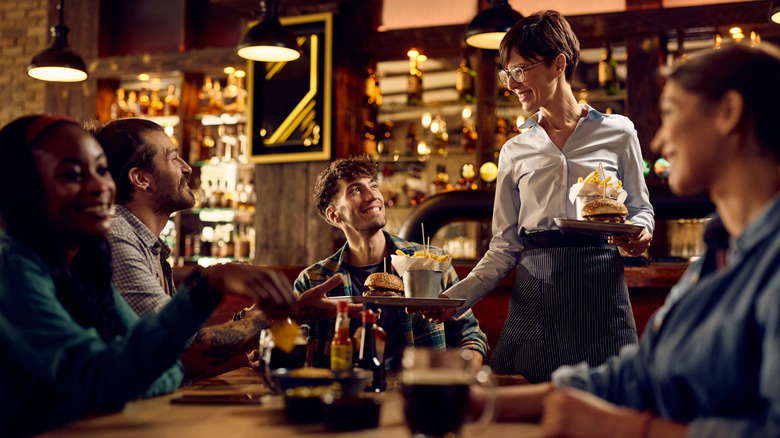
Drinking booze alongside a meal has been a part of American culture for centuries. Yet although an engrained practice nationwide, it's all too easy to forget that states – not the federal government – take the lead on legalities of imbibing. Such regional regulation creates a wide array of laws, which can drastically impact the customer experience — sometimes in unusual ways.
For example, stop by any restaurant in Virginia, and food plus non-alcoholic drink transactions must comprise at least 45% of sales. Enforced for businesses with mixed beverage licenses, this essentially applies to eateries big or small that sell cocktails, beer, wine, and spirits to accompany food. Intriguingly, Virginia only hands out on-premise beer and wine licenses, not for spirits, meaning even traditional bars must operate as restaurants. Currently, beer and wine don't count towards the sales tally.
Subsequently, how businesses choose to attain such a ratio varies. For one, the state government mandates the constant sale of food amidst opening hours; so no tipple sans snack. Given that the typical American full-service restaurant generates 21% of total sales from alcohol, per 2023 data from the National Restaurant Association, food focused establishments don't struggle. Yet, as the ratio applies universally to restaurants of all sizes and styles, others must turn creative. For instance, a whiskey-focused business, small drinking-centric Japanese izakaya restaurant, or Virginia cocktail bar need to employ savvy strategies, or else the concept simply won't survive in the state. Some adjust prices, market food-focused happy hours, or cut-off drinkers to attain the ideal mix.
The backstory of Virginia's regulated food and alcohol sales
As with most of America's peculiar alcohol laws, origins trace back to Prohibition. The state already contained a multitude of dry counties by the start of the 20th century, which escalated to a total ban of booze production and sales by 1916. Then, the passage of the 18th Amendment in 1920 commenced Prohibition, cementing a rigid stance on alcohol in Virginia. Even for decades following the repeal, the states' restaurants couldn't sell a drop of liquor, until the 1968 Mixed Beverage Act. This legislation initiated the ratio rule, first scaled at 51% food sales until a rework to its current form in the 1980s.
The mandate never fully normalized. With changing alcohol trends — like the rise of cocktail culture – business owners are fighting back, with a potential bill rework still on the table (as of March 2026). Yet for now, Virginians are used to ordering a bite on a night out and you still won't find a dive bar or other bars focused solely on the booze in Virginia. Reminiscent of the drinking rule you'll have to follow at restaurants in Utah, it's one of the more unusual alcohol policies in the U.S.