

How Many Girl Scout Cookies Are Sold Every Year? Hint: It's A Lot
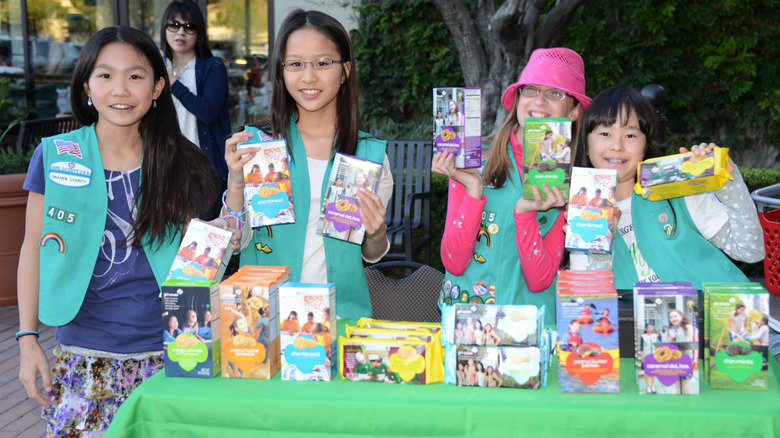
Girl Scout cookie season rolls around annually just in time to chase away the winter doldrums, usually running from January to April. Americans eagerly greet the return of their favorite flavors and support the Girl Scouts in their lives or the organization in general by snapping up a massive amount of cookies. Some 200 million boxes are sold during those few months, outpacing Oreo's sales for the entire year (per NPR). That doesn't even take into account the lower-cost dupes companies produce to meet the demand during the rest of the year, like the copycats sold by Aldi.
Prices are established by the local Girl Scouts councils, so they can vary across the country. But after some inflation-related increases in recent years, the boxes are now generally $6 to $7 each, which adds up to a whopping $1.2 to $1.4 billion in sales each season. Additionally, some 700,000 Scouts sell cookies annually, working out to around 285 boxes sold by each of them. A six-year-old Pittsburgh girl who's in the earliest troop level, Daisy Scouts, broke the single-year record in 2026 by selling more than 100,000 by mid-February alone. Pim Neill's social media-driven effort blew away the 32,000-box former season high.
Cookies can be bought online in addition to traditional sales at booths in communities or through a Scout you know. Buyers can use links from a specific Scout or troop, or search on the Girl Scouts website to be directed to a link for one in the area. All the profits go to the local councils and troops for activities and expenses, not the overarching organization.
The cookie flavors available now in the more than 100-year-old sales program
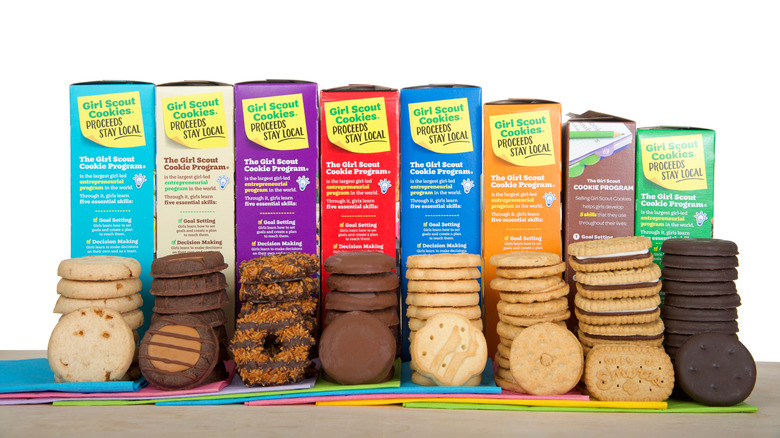
There are 11 Girl Scout cookies available in 2026 — and we ranked them all – after a new one was introduced for the season and two others were discontinued. The rookie Exploremores is a sandwich version based on rocky road ice cream, with chocolate, marshmallow, and toasted almond crème flavors. The Toast-Yay! was one of the two retirees, a toast slice-shaped cookie that tasted like maple-y French toast and had white icing on the bottom. Also bowing out was the S'more, which had graham cracker-flavored tops and bottoms around a chocolate and marshmallow interior.
The Thin Mints reign as the most popular choice, followed by the Samoas ( also called Caramel deLites), Tagalongs (aka Peanut Butter Patties), Do-si-dos (Peanut Butter Sandwiches), and the Lemon-Ups (Lemonades). Two different baking companies make them, ABC Bakers and Little Brownie Bakers, so they have different names and may have slightly different ingredients depending on which one they came from.
The origin of the sales program goes back to cookies sold by a Muskogee, Oklahoma, troop at their high school in 1917, not long after the Girl Scouts organization was established. They were baked by the members themselves in the early years, with many troops using a basic sugar cookie recipe. It eventually spread across the organization nationally in the '30s, and the cookies began to be made commercially. The first homemade ones were 25 to 35 cents for a dozen, and the first nationwide commercially-produced boxes in 1936 were around 23 cents.