

Redditor Exposes Texas Roadhouse's Shady Tipping Tactic: Do The Math
Although Texas Roadhouse sells affordable steaks and offers free complimentary rolls, a pricing mishap nevertheless troubled customers. As outlined on a Reddit post, an acute customer noted a suspicious incident: A suggested 15% tip on a total of $80.68 worked out to $13.45 — which, algebraically, should be $12.10. The user noted they ended up tipping a greater amount, but still, the deception hurts. "How are they even getting $13.45 as the 15%???" they asked.
Even for generous tippers, the sentiment is understandable. No one likes being deceived into overspending by way of faulty math. Some might suspect the inclusion of tax — a sum that's contentiously employed for tipping calculations– caused the mishap. However, the included receipts show that the $80.68 total was already a post-tax amount.
Instead, the excess $1.35 tip came by way of a coupon the poster had used. The user cashed in on a complimentary appetizer worth $8.99, so although the discount was reflected in the printed total, it was still utilized to calculate tax — and thus, tip. In defense of Texas Roadhouse, the tipping screen did explain this, displaying the disclaimer, "Tip is calculated after tax and before discounts." Still, when speedily checking out post-meal, it's understandable that such details aren't noticed, adding unwanted stress to settling the bill.
American consumers often feel discouraged by pre-calculated tips
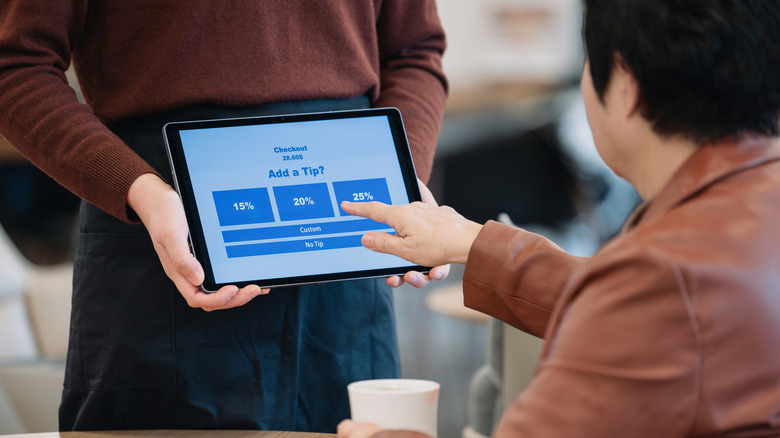
While so ingrained in the U.S., tipping is not customary in many regions. So as gratuity expectations escalate, many Americans feel increasingly discouraged by the practice. Intriguingly, the use of suggested tip amounts on a digital screen – precisely the interface employed at Texas Roadhouse — serves as an especially common source of tension with consumers.
Even on traditional paper receipts, consumers often forgo tipping on pre-discount totals — although it's polite to compensate wait staff for the full value of foods and beverages. The presence of electronic gratuity only further complicates the issue. Presented options on a screen, consumers feel disgruntled by the expectation of overly generous gratuity. To add to the troubles, digital suggestions proliferate in previously unused contexts — cafes, shopping, self-checkout — forcing consumers to ask questions like do fast food workers get tips?
All such negative sentiment rolls over into the dining realm, like when finishing a steak dinner at Texas Roadhouse. By including the discount and tax, the steakhouse chain technically adhered to considerate tipping practices, yet still, the digital presentation appears deceitful. Many businesses are employing electronics to inflate suggested tipping sums, so many consumers feel cautious, rather than altruistic, regarding gratuity. Others might hit the designated, socially expected amount and not notice the details. Either way, the removal of mechanical pen and paper tipping often aggravates rather than eases, leading to such tempered Texas Roadhouse experiences.