

For Restaurant-Worthy Ramen, Make Your Soft-Boiled Eggs Like This
We may receive a commission on purchases made from links.
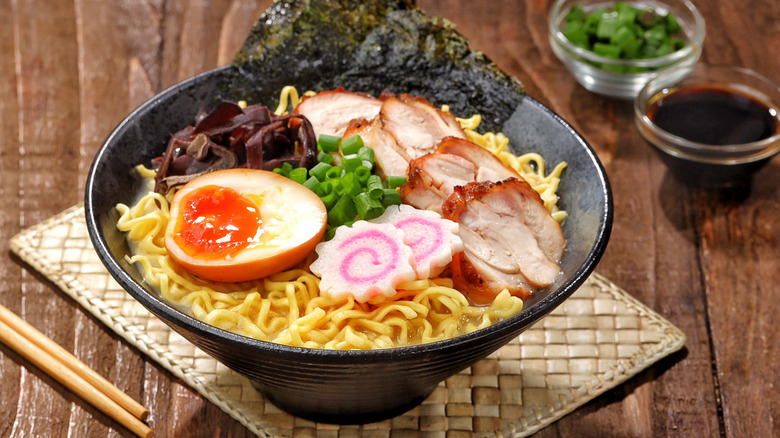
While you can certainly crack an egg directly into ramen, nothing quite compares to the jammy center, flavorful white, and tenderness of a great Asian marinated egg. While simple to make well, getting them perfectly soft-boiled is all about timing and technique, and the right tools go a long way toward achieving the ideal end result.
An egg piercer, such as the one offered by Eggssentials, used on the flatter end of the shell vents air pockets that can pressurize under heat and crack the exterior. Plus, it helps make peeling easier, allowing you to keep the white intact and giving your bowl a better presentation. Adding a bit of salt to the water also helps maintain their appearance; while it's a common kitchen tip for buoyancy, its real magic is acting as a "sealant" — if a shell does crack, the salt helps the egg white coagulate instantly to plug the leak. Once submerged and cooking away, give them a gentle spin about 30 seconds in. This helps move the still-fluid yolk around, centering it and preventing it from hardening all the way at the edge of the shell.
Just like steak, nailing the doneness of your eggs is all about timing. If you want a solid white but an extra-gooey interior, four minutes in the water is all you need. If, however, you prefer the firm creaminess of a fully set yolk, you can increase this to seven or 10 minutes. Either way, precision is king here, so be sure to have an ice bath ready to keep your eggs from overcooking once removed.
Proper marinade and timing create the perfect ramen egg
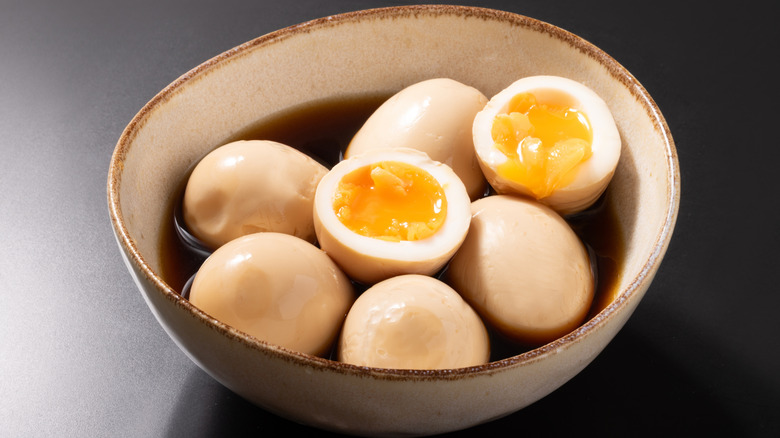
Both the inner and outer whites of an egg love to drink in marinade, so striking the right balance of flavors keeps you from ruining hours of waiting. You want something salty to complement your ramen, complex enough to stand out, but not so overpowering that you can't taste the broth.
The base of a great ramen egg marinade starts with two different types of soy sauce — light and dark — and mirin. Light soy sauce provides most of the saltiness, while darker varieties give a rich color and powerful soy flavor. Mirin is a sweet Japanese cooking wine that balances the salt with some sugar while adding a bit of complexity from fermentation. If you choose to use sugar instead, try to find something with a bit more molasses, like turbinado, so your dish still has greater depth of flavor than you'd get from white granulated types.
How long you let your eggs marinate has as much impact on their flavor as the marinade itself. At a bare minimum, you must let them sit, fully submerged, for two hours to develop any flavor at all. When you cut them open, however, you may notice that only the bare exterior of the white has taken on color. For better taste and appearance, try to let them sit for between 24 and 48 hours. If you don't finish them all in one sitting, remove them from the marinade, pat dry, and store them in an airtight container for up to five days.