

If You Discover This In Your McDonald's Filet-O-Fish, Don't Panic

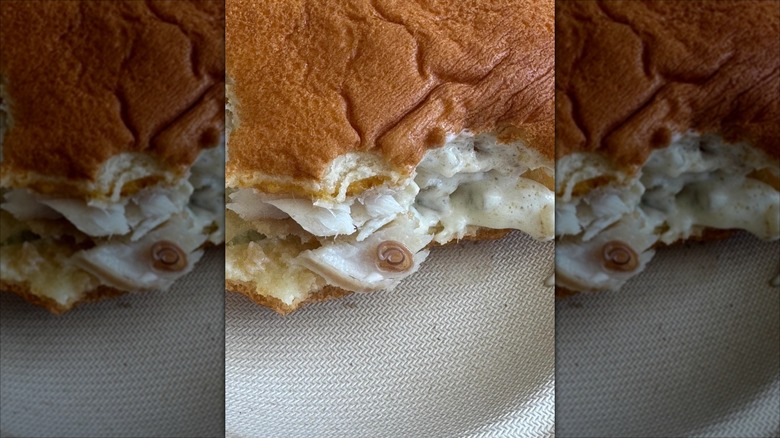
If you're a fan of McDonald's Filet-O-Fish, the chain's lone fish-based sammie with its iconic square shape, you might have an unexpected, ahem, guest in your sandwich. To illustrate the point, a customer took to Reddit to show their partially consumed FoF, which had a little, curled-up object — somewhat resembling a tendril of grilled onion — resting on the fish patty. "Parasite in [the Filet-O-Fish]?" the Redditor posted.
Other Reddit users responded — some with reactions of disgust, others with revelation. "Former fishmonger here — congrats on finding a nematode!" one poster responded. Nematodes are parasitic, cylindrical worms, also called roundworms or cod worms, and they're especially common in wild-caught fish. The meat patties in McDonald's Filet-O-Fish sandwiches are composed of wild-caught Alaskan pollock, per the McDonald's website, using "fish sourced from sustainably managed fisheries."
The self-identified fishmonger assured the original poster that the presence of such creatures is quite common and nothing to worry about. They went on to say that anyone who has eaten fresh or frozen wild-caught fish has, undoubtedly, eaten a nematode. "It's totally normal and doesn't present any risk to [your] health, or affect taste or texture, provided [that] it's properly prepared (cooked through, or frozen in a manner for raw consumption)." Information from the CDC confirms this — properly freezing, storing, and cooking fish eliminates the health risks should you inadvertently ingest a nematode.
Granted, while it may not be dangerous, finding a worm in your food could certainly put a damper on your appetite, resulting in an un-happy meal, if you will. Most will likely go unnoticed, but it isn't exactly unheard of for people to find worms in their fish — even at McDonald's.
The likelihood of finding a nematode may be increasing
Nematodes can be present in any type of wild-caught fish, and higher ocean temperatures are reportedly making some worms show up more abundantly, according to a 2020 study for Global Change Biology. In 2022, a McDonald's executive addressed industry leaders gathered at the Genuine Alaska Pollock Producers annual meeting, urging them to crack down on product quality, as the company was encountering "more challenges with nematodes, bones and other foreign objects than we've seen in a long time" (per IntraFish).
Similar to the increased popularity of farm-to-table food, the demand for "sea to table" produce is growing. Consumers want wild-caught fish, and they're willing to pay more for it. For a company like McDonald's, advertising a fish product that is wild-caught is a major marketing boost. And Mickey D's isn't the only chain serving up wild-caught fish. Burger King similarly uses wild-caught pollock in its Big Fish sandwich, and Culver's uses wild-caught fish in its seafood menu items, as do various other chains.
Ironically, though it's less appealing to consumers, farmed fish — raised and harvested in controlled environments — are less likely to have parasites like nematodes. Farmed fish are segregated from the wild ocean environment, where parasitic infection most commonly occurs, and they consume feed that is heat-treated to kill parasites.
The bottom of the fishing line is this: If you're eating wild-caught fish, you're probably eating worms, too. Getting a fresh and crispy Filet-O-Fish by requesting a freshly cooked sandwich won't circumvent the problem, and proper freezing and cooking practices won't remove the critters from your fish, either — they'll just ensure that if you do eat a worm, you can rest easier knowing it was dead.