

Here's Why Walmart Doesn't Sell Boar's Head Meat
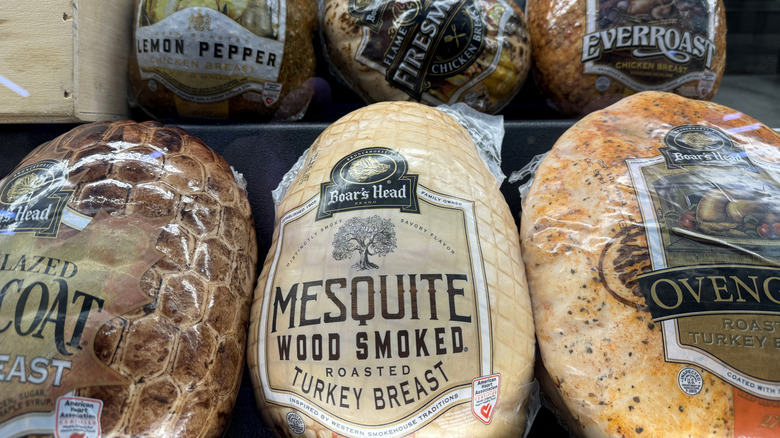
Walk into a Walmart SuperCenter, and you can expect to find many recognizable brands; the huge stores stock some 200,000 SKUs, after all. So, whether you're grabbing essential cured meats for the fridge or a grocery store deli sub for lunch, it might come as a surprise to not see a single offering from Boar's Head. The ubiquitous brand is an industry giant, even outperforming the sales of Tyson and Oscar Meyer at the deli counter. You can find its many products – which include everything from hams to processed chicken, bacon, and even condiments — at nationwide chains like Kroger and Albertson's.
Walmart, however, only stocks a handful of condiments like Boar's Head mustard and mayo, without a single meat product in sight. The absence is no mere coincidence, but rather a clash of ethos that sheds light on the logistics of both companies. It's likely the lack of collaboration emerged on Boar's Head's end, a corporation with a notoriously tight-lipped operation style.
Keen to uphold an upscale and epicurean brand image, the company steered away from Walmart's cost-effective price model. Boar's Head products have historically come at a higher price, and tapping into Walmart's ruthlessly money-optimized supply network means, inevitably, selling at a lower profit margin. Not to mention, Boar's Head curates its products to stand out — both via a recognizable label and occasionally even a standalone fridge – a kind of special status Walmart wouldn't provide.
Boar's Head and Walmart both employ strict business practices

The ins and outs of Boar's Head and Walmart's relationship remain an industry secret. Still, the publicly revealed workings of the deli meat giant and the world's second biggest company could help explain a rift. Founded in 1905, Boar's Head started as a small-scale Brooklyn-based deli, steadily growing a large distribution network over the decades. Toward the end of the 20th century, the company took on an unusually rigid distribution system — outsourcing to suppliers but mandating strict operating logistics. Furthermore, Boar's Head also dictates meat sales at the retailer itself, like requesting branded aprons for deli workers.
Such Boar's Head sales strategies have continued to evolve, but they point to an ethos that could clash with Walmart's own stringent supplier demands. The retailer has come under scrutiny for details like charging extra fees, sporadic payment times, and dictating store stock and placement based on supplier performance. It's a business approach that has aligned for Boar's Head bottled condiments, but not packages of cured and uncured meat. Furthermore, Boar's Head experienced a large-scale, devastating recall in 2024 — a blow to brand image — making a future Walmart and Boar's Head agreement even less likely.