

The Italian Street Food That Combines Everything In A Handheld Meal
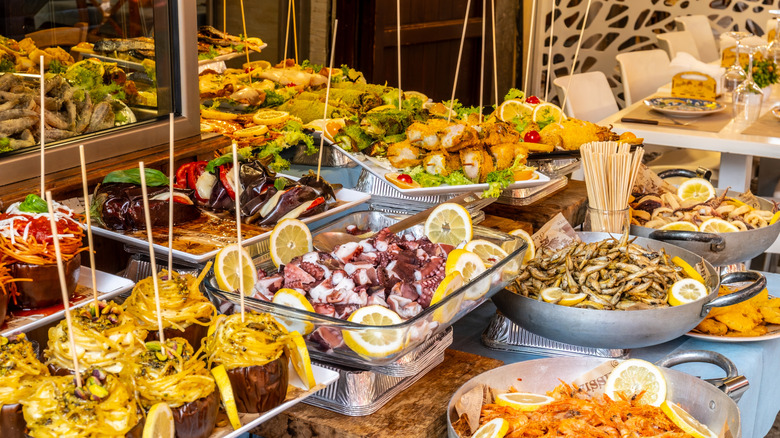
Few countries can compete with Italy's vibrant street food scene, and if you were to ask an Italian to list the dishes you should try at least once in your life, arancini are almost guaranteed to come up — especially among Sicilians. This beloved regional delicacy is like heaven rolled into a handheld ball, featuring risotto — one of the most essential Italian ingredients – shaped into a ball with a variety of fillings, all coated in flour, egg, and breadcrumbs, then fried for a crispy bite.
Today, you can get your hands on arancini pretty much anywhere in Italy, but their presence is felt strongest down south, especially in Sicily. Some claim the development of arancini in this region can be traced back to the 9th century, when the island was under Arab rule, and rice was first introduced to the region. The later development of the breading is attributed to Federico II, who was a great fan of the rice ball but wanted a way to carry it during hunting expeditions.
Interestingly, while arancini al ragù (arancini stuffed with a meat-based tomato sauce) is one of the most recognizable versions today, early fillings looked very different. That's because, despite their close relationship with Italian cuisine, tomatoes didn't become a staple in Italy until the 18th century.
While arancini are enjoyed year-round and can be found sold everywhere from humble street food kiosks to high-end restaurants, they also carry deep cultural significance. In certain parts of southern Italy, they're traditionally eaten during the Feast of Santa Lucia on December 13th, which is held annually to commemorate the arrival of a grain ship during a devastating famine.
The possibilities are endless when making arancini
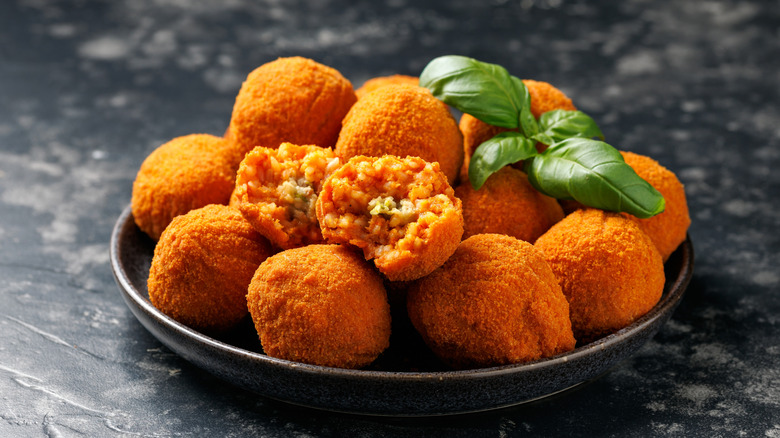
Arancini have an interesting etymology, translating into English as "little oranges," referencing their round shape and golden, citrus-like hue. But the name is only the beginning of their appeal. While most arancini feature risotto rice and a crisp breaded coating, the beauty of them lies in their versatility, and you can stuff almost anything inside.
While the most traditional fillings typically feature a meat ragù with peas and cheeses, you can find plenty of variations. One of the most popular fillings is mushroom for a rich, creamy filling with an earthy flavor. Up north in Milan, you can find saffron arancini, a take on the iconic risotto alla Milanese, which gives the rice a vibrant yellow color. In coastal towns and cities, arancini are sometimes even filled with frutti di mare, a mixture of seafood that brings a classic Mediterranean feel to the dish. When it comes to fillings, our logic is simple — if it would go well in a risotto, it'll probably be just as tasty stuffed in an arancini.
In Italy, there are also several fascinating regional takes on arancini — including debate over whether they're called arancino or arancina. In Palermo, you'll find the round arancina. In eastern Sicily, however, you'll instead find cone-shaped arancino, a nod to Mount Etna, which towers over cities like Catania and Messina. If you'd like to broaden your rice-ball horizons even further, head over to Naples and try palle di riso, small breaded balls with a simple filling of risotto and cheese.