

How Texas Roadhouse Handles Prime Rib From Roast To The Moment It Hits Your Plate
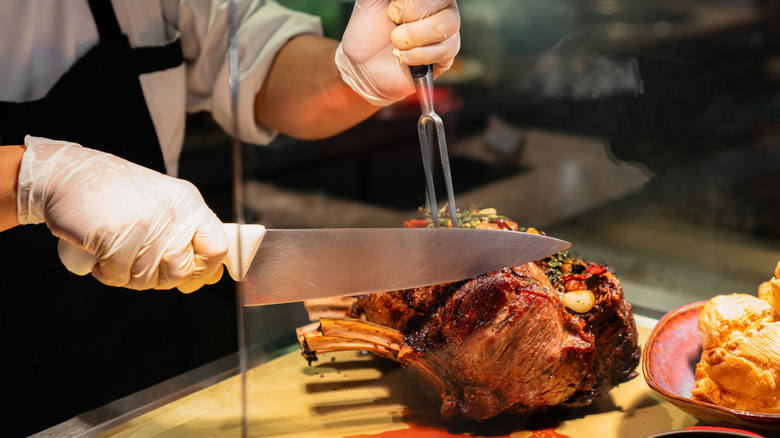
Popular chain steakhouses draw customers by offering not only budget-friendly prices but also a good variety of cuts to choose from. The best-selling steak at Texas Roadhouse is also one of its most affordable, the six-ounce sirloin. Meanwhile, the prime rib is among the most expensive, behind only the porterhouse T-bone and the bone-in ribeye. There are a number of steps that go into making the tender and richly flavorful classic cut, from when the meat arrives at the restaurant until the server brings it to the table, and it's different from how the others are handled.
The rest of the steaks are grilled after they've been hand-cut by the on-staff butchers at each Texas Roadhouse, but prime rib is first cooked as a roast and then carved into thick slices. The beef, which comes from the primal rib between the cow's shoulder and loin, is prepared by the butchers into roasts that the chain calls logs. Once in the kitchen, they're coated all over with a rub of soy sauce, safe-to-cook-with liquid smoke, minced garlic, sugar, oil, kosher salt, and pepper, and left to marinate overnight. The soy sauce's acid works to penetrate the meat, so the flavors get in, while the sugar will caramelize as it cooks and help form the crust.
The logs are first seared in a 500-degree Fahrenheit oven for 15 minutes and then go into an Alto-Shaam, according to a former Texas Roadhouse manager Redditor, which is a cook-and-hold oven. There, they are slow-roasted at a low heat and held at a pre-programmed temperature once done, an overnight process that keeps them moist. Heat probes inside the meat make sure the right temperature is maintained.
What happens once you place a prime rib order?
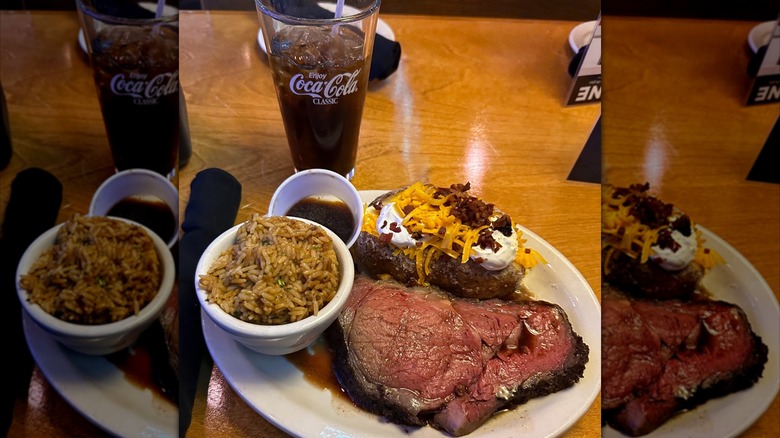
The prime rib comes in a choice of sizes, either 12, 14, or 16 ounces, and different levels of doneness. Another Redditor who claimed they used to work at Texas Roadhouse said the roasts are cooked to two different temperatures, some for rare and medium rare orders and others for the medium wells and well dones. Customers' servings are carved from the appropriate one depending on how they've ordered it. The poster also claimed that anyone can request an end cut, which has more of the crust and the most flavor.
Prime rib orders come with optional au jus, horseradish, or creamy horseradish, and two sides (we ranked them all to find the best). There are also toppings available for an extra cost: sauteed mushrooms and onions, bleu cheese crumbles, or jack cheese. Prices vary by location, but representative ones at a Houston restaurant are $24.49 for the 12-ounce, $26.99 for the 14-ounce, and $29.49 for the 16-ounce.
Because of the lengthy marinating and slow-cooking, the logs have to be made in advance, unlike the other steaks, so the restaurants have to gauge how much to prepare for each day based on normal patterns. But if it happens to be busier than expected, or the prime rib is particularly popular one night, it could sell out. Since the supply can't quickly be replenished by just cutting more steaks, customers who want it would unfortunately be out of luck.