

How Oysters Rockefeller Were Created In 1899 As A Replacement Dish
We may receive a commission on purchases made from links.
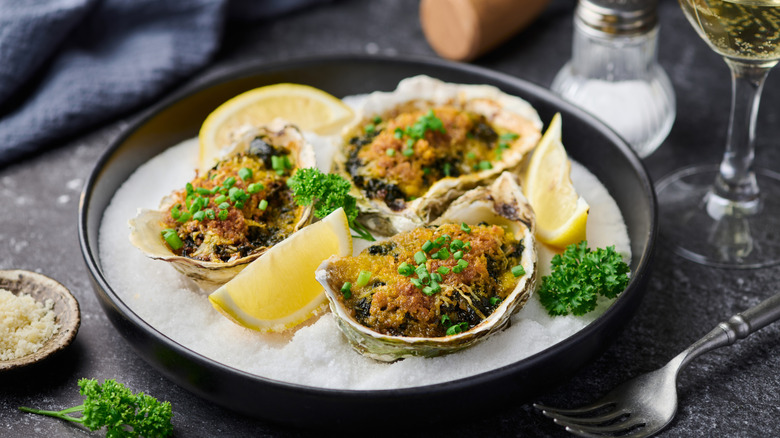
With a name like oysters Rockefeller, you might think the classic seafood dish was first made by a fancy New York restaurant where Wall Street's wealthy movers and shakers gathered. But in reality, it was created in 1899 at a still-operating French-Creole restaurant in New Orleans, a very different city that is home to gumbo, jambalaya, and beignets, its quintessential dessert. The origin story is actually one of necessity being the mother of invention and then turning into something spectacular. Antoine's Restaurant chef Jules Alciatore came up with the oyster dish as a replacement when it became difficult to get snails for one of the usual menu items.
The son of Antoine Alciatore, who founded the restaurant in 1840, Jules had a hard time obtaining Burgundian snails from France and decided to swap in oysters, which were abundant in the Gulf waters off New Orleans. He made a few tweaks to the recipe as he substituted the mollusks for the snails, covering the oysters on the half-shell with a green sauce and baking them. Customers loved the result, which was also a departure from the usual practice at the time of eating them raw.
The name was chosen to reflect the richness of the sauce, as John D. Rockefeller was the world's richest man at the time, as well as its green color, like U.S. paper money. Antoine's, now the oldest restaurant in New Orleans, still has the famous dish on its menu.
So, what's in the original oysters Rockefeller sauce?
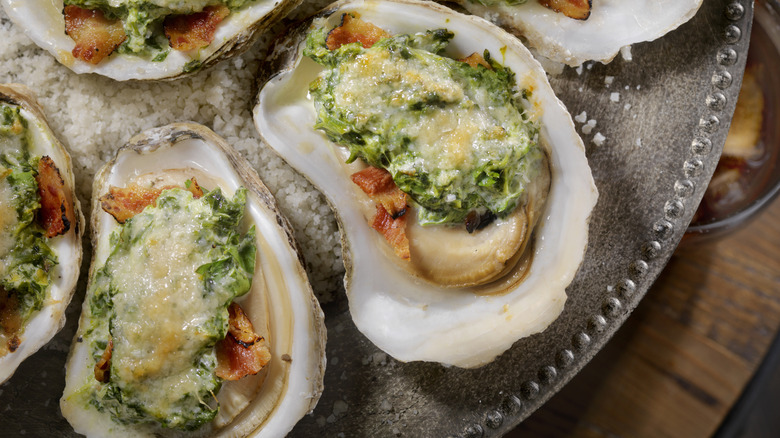
Jules Alciatore kept his oysters Rockefeller recipe secret, and his descendants, who continue to run Antoine's as the oldest family-run restaurant in the country, have done the same. But that has not kept people, since the time of its invention, from trying to suss out the Rockefeller sauce ingredients. Versions of the dish often appear on restaurant menus, usually with breadcrumbs and sometimes grated cheese on top.
Spinach is a common ingredient in replicas for "authentic" oysters Rockefeller, even though Antoine's chefs have said it is not part of the recipe. Alciatore descendant Roy F. Guste Jr. said the same in his 1979 "Antoine's Restaurant Cookbook," revealing that several green vegetables are pureed for the sauce, but spinach is not one of them. But a big reason people think so is that Jules' son Roy Alciatore put out a near-version recipe in 1948 that does include the leafy veggie, along with onion, Tabasco, butter, and the anise-flavored liqueur Herbsaint. Someone managed to bring an oyster from Antoine's to a lab in 1986 to have the sauce analyzed, and the results showed parsley, celery, green onions, capers, and olive oil.
Herbsaint was developed in New Orleans as a substitute for absinthe after that popular liqueur became illegal in 1915 (it is now legal again in the U.S.). Its inclusion in the 1948 recipe suggests absinthe may have been in the original sauce. Some oysters Rockefeller recipes use yet another anise liqueur, Pernod, instead.