

Spanish Vs Mexican Tortillas: Is There Really A Difference?
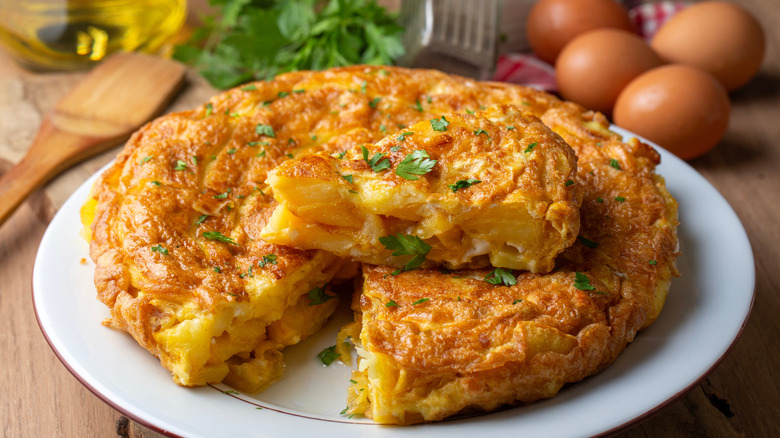
By way of three centuries of colonial rule, Spain and Mexico share the same language. Yet Spanish doesn't always apply the same in the culinary realm — as witnessed by the term tortilla. Spanish for "little cake," the word refers to two foods that couldn't be more different. Request a tortilla in Spain, and you'll get what's essentially a bulky omelet, traditionally filled with potatoes and onions. Meanwhile, a Mexican tortilla refers to a large variety of unleavened flatbreads, broadly categorized into flour or corn.
The origins of such a naming overlap date back centuries. In Mexico, various civilizations had already crafted corn-based flatbreads as far back as 3000 B.C. In Nahuatl — the Aztec language — the dish was called tlaxcalli. According to legend, the word's sonic resemblance, combined with its circular shape, was enough for Spanish conquistadors to lend it the name of their beloved omelet.
Afterwards, culinary exchange occurred in both directions. The European-originating omelet dish was incorporated into Mexican cuisine and referred to as tortilla Española (Spanish tortilla) for differentiation. The Spanish also carried the flatbread tortilla concept back to the Old World, but a stronger fusion occurred in the Americas. Spanish religious settlers spread wheat throughout North America, laying the seeds for wheat tortillas. In this way, the transcontinental tortilla dialogue continued, showcasing the complex collision of Spanish and Mexican culinary culture.
The Spanish tortilla evolved over centuries
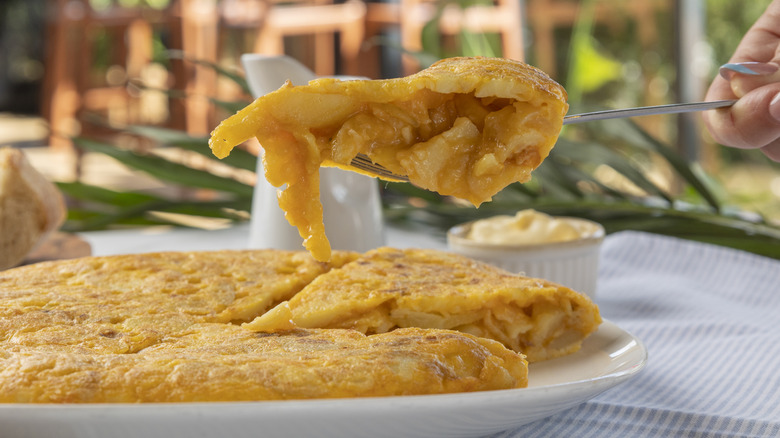
Visually, it's hard to mistake a Spanish tortilla for a Mexican one. Among the most noted Spanish egg dishes, it is a fluffy, large omelet with a rich history. Consumption of similar whisked egg dishes was already noted upon Spanish arrival to the New World in the 16th century. However, such a tortilla still lacked a key modern component — potatoes.
Curiously, the Spanish tortilla exchange went both ways, with the now-essential spud carried over from the New World by way of Peru. Tubers were integrated into Spanish cuisine by the 17th century, yet the modern version of the tortilla — made with potatoes, eggs, and onions — likely only solidified in the early 1800s. Like the Mexican tortilla, it's a beloved dish with abundant variation. The consistency can range from a firm, frittata-like structure to a runny egg interior. The inclusion of onions remains a divisive topic, and seasonings are typically minimal, with salt as the central component. Enjoyed hot or cold, at the tapas bar or in the home, the Spanish tortilla is a national treasure that cleverly melds just a few ingredients.
The flatbread-like Mexican tortilla has long served as a dietary staple
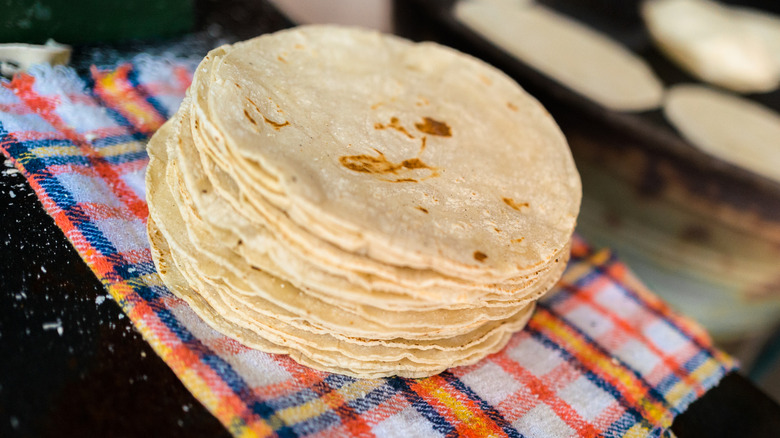
Beyond the shared name, the Mexican tortilla has little in common with the Spanish omelet. Instead, the flatbread-style tortilla has functioned as a nutritional cornerstone in North America for millennia. Traditionally crafted from dozens of corn varieties, tortillas are made from flattened masa, a versatile dough created using nixtamalization. This foundational alkaline-soaking process — typically done with slaked lime or ash-derived lime — removes the outer husk of dried corn kernels and makes the contained niacin bioavailable. As a result, nixtamalization not only forms a soft, workable dough, but delivers critical nutritional benefits, cementing tortillas as an essential part of the Mesoamerican diet long before Spanish arrival.
Later, Spanish settlers introduced wheat, leading to the creation of flour tortillas. Now popular in both the U.S. and Northern Mexico, this type of tortilla is made using a process akin to bread-making. Flour, salt, water, and a fat — which might be lard, butter, vegetable oil, or even bacon fat depending on the region — are kneaded into circular flatbreads of varying thickness and diameter. Today, both corn and flour tortillas are found in many varieties throughout Mexico, the U.S., and increasingly across other continents. Serving as the base for an extensive list of dishes — ranging from street tacos and burritos to enchiladas and even crispy breakfast tostadas — the tortilla continues to thrive as a beloved and essential culinary staple