

How Do Apricot Trees Fare In Cold Climates?
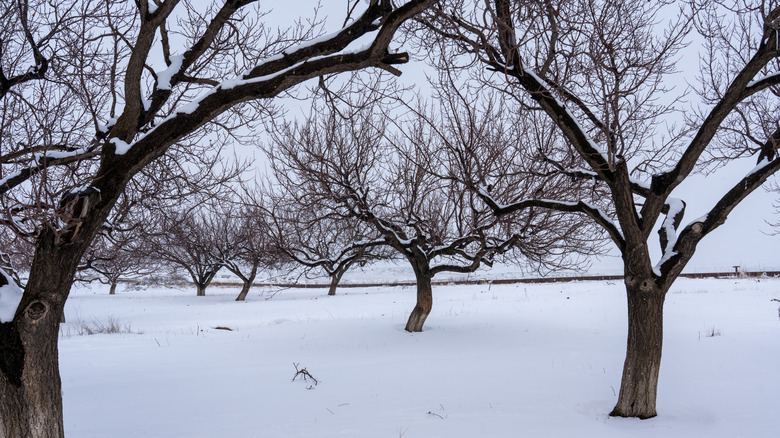
Whether it's the time of year, the type of soil, or the quantity of sunlight, there is a lot to consider when planting an apricot tree. Yet an especially critical consideration is the climate — if the weather in your area isn't right, there's simply no potential for the plant to survive. Pinpointing passable living conditions can be tricky, so Food Republic spoke to Steve Corcoran, the CEO of Lawn Love, to find out more.
According to Corcoran, the plants "do a decent job surviving cold winters," making apricot trees a great contender for Northern regions. Typically, the fruit tree is grown in USDA Zones 5 to 8, meaning most fruits can easily withstand temperatures that dip down to some -20 degrees Fahrenheit. Oftentimes, apricot trees will even survive cold spells that reach -30 degrees Fahrenheit, and a few select bred cultivars — like the Brookcot or Scout — can live through -40 degrees Fahrenheit.
Apricot trees were first domesticated in China, and are now grown on every inhabited continent– a sign of their tolerant abilities. Corcoran noted the plants "actually prefer colder climates over hot ones," with some specific varieties tailored to the chilly temperatures of Canada, Mongolia, and Russia. Nevertheless, as with many other fruits, California leads production in the United States. The state's Mediterranean climate may be ideal, but you can grow this popular summer fruit in many colder regions, too.
Protect apricot trees during cold spells
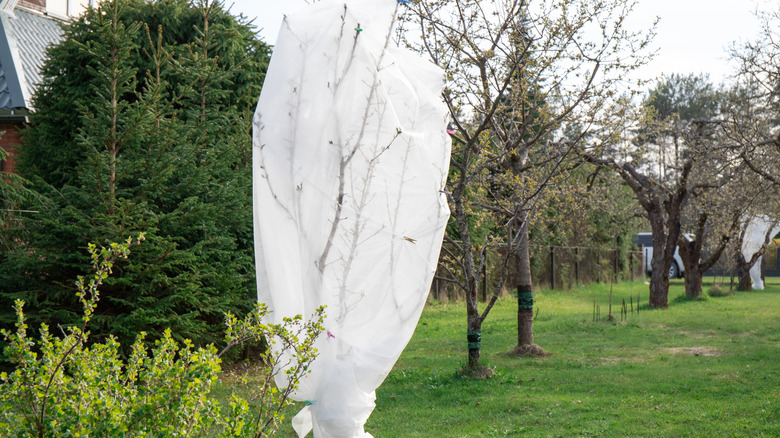
Even though apricot trees are so hardy, Steve Corcoran recommended still supporting the fruit during cold snaps. Not only can frost limit the quantity of produced apricots, but the individual plant's genetics affect cold temperature tolerance, too.
For an easy precautionary step, Corcoran said to "[add] mulch to insulate their roots." Applying such a planting mix not only offers root temperature regulation but also helps retain moisture inside the ground. Once the cold spell arrives, Corcoran advocates covering young apricot trees "with some kind of breathable fabric," thereby offering a barrier against wind chill and upping bark protection. Meanwhile, for older fruit trees, Corcoran explained that you should be "wrapping their trunks as high up as you can." Such a technique is critical to protect against sun scald, a disfiguration that occurs when bark experiences temperature fluctuations.
Take such simple safeguards, and you can plant apricot trees in the majority of the country. Then, once the warm weather rolls around, enjoy the stone fruit in a roasted apricot sherbet or stuffed with mascarpone – it's a foodstuff worth the extra care.