

Why This Arby's Bread Ingredient Is Banned In The EU But Not The US
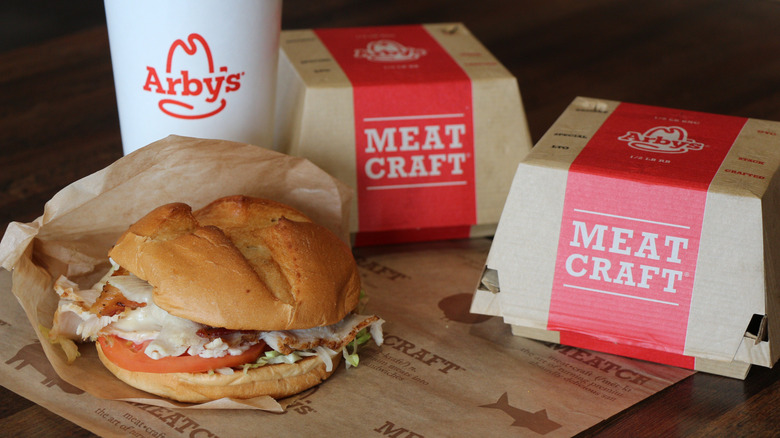
The fast food chain Arby's has faced varied controversies over the years, with issues recently spilling over into international realms as well. The chain operates over 3,000 locations stateside, but outlets also exist in several countries, ranging from South Korea to Kuwait and Canada. A region largely absent from the list of current operations is Western Europe — likely in part due to azodicarbonamide, an additive that was present in several of Arby's bread products in January 2025.
Azodicarbonamide (often abbreviated as ADA) is used as a flour treatment agent to whiten cereals and produce extra gas to give dough an enhanced rise. Yet such foaming qualities are also utilized in industrial applications like plastics and foam materials, leading to ADA's nickname as the "yoga mat" chemical. Arby's uses the additive in specific menu items, as ADA showed up on a January 2025 ingredient list of its croissant and sourdough breakfast bread.
Nevertheless, the European Union has banned the substance since 2005 and doesn't even allow its use in food-containing vessels. The risk comes down to potential carcinogenic qualities: as outlined by the Global Food Regulatory Science Society, particular conditions cause ADA to turn into a known carcinogen called semicarbazone. Yet the FDA — which currently approves the use of ADA in small quantities — states that tumors emerged exclusively in female rats, at a concentration humans wouldn't ingest. Still, azodicarbonamide takes on contested status in international food regulation, with a ban also enforced in Australia.
Some of Arby's products contained a controversial additive

In the U.S., consumers are used to trusting the FDA's stance, whether for guidance on what constitutes a "healthy" label on foods or regarding the ban of a substance, like the high-profile prohibition of Red Dye No. 3 in January of 2025. Yet, as with all regulatory agencies, even a research-backed stance can be debated, so it's worth noting the intricacies as a consumer. After all, it's reasonable to avoid buying certain ingredients in whole wheat bread, so such careful consideration should apply to additives, too.
Concerning azodicarbonamide, the general consensus remains indeterminate, but the health detriments are manifold. Although rare, research shows that in industrial contexts, the chemical can induce asthma, as per multiple studies published by the National Library of Medicine. Furthermore, heat exposure causes ADA to transform into not only semicarbazone, but also urethane — which the U.S. Department of Health and Human Services deems a "reasonably anticipated" carcinogen.
The debate comes down to whether (officially) food-safe concentrations pose a real risk. Yet the research isn't comprehensive, and especially since the chemical isn't essential, many advocate for total elimination. Back in 2014, the non-profit Environmental Working Group found ADA included in around 500 bread products from widespread brands. Spurred by additional petitions, fast food giants like Subway and McDonald's, and even retailers like Walmart, have halted sales of products with the ingredient. The compound is in the limelight once more, as of May 2025, with the FDA planning to reexamine the additive. As of December 2025, it is unclear if Arby's completely got rid of ADA on its ingredients list.