

Why American Tequila Tastes Stronger (And Hits Harder) Than Its Mexican Counterpart
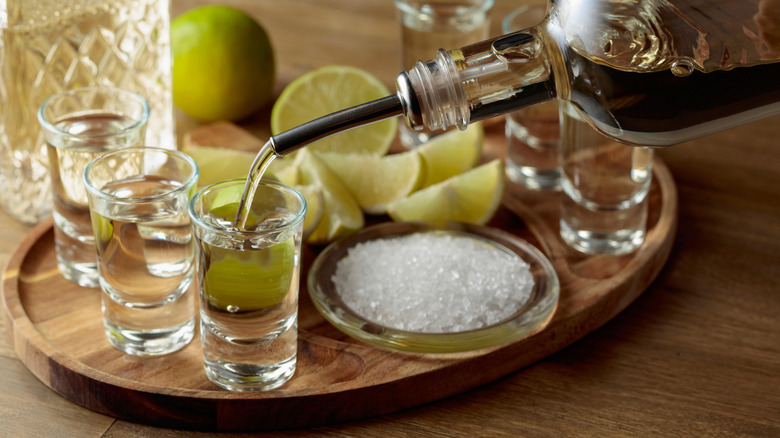
Although tequila may be legally bound to Mexico, your margaritas or palomas might actually hit harder north of the border. The reason for this simply comes down to different national laws governing the minimum alcohol by volume (ABV) that's required to be in the agave-based spirit. To find out more, Food Republic spoke with Dusan Sudimac, bar manager at Vera Cocina.
"In the United States, U.S. law requires most distilled spirits, including imported tequila, to be bottled at a minimum of 40% ABV (80 proof)," Sudimac told us. "In Mexico, tequila sold for the Mexican domestic market is commonly bottled at a lower ABV, typically 35% to 38%." Following distillation, tequila comes off the still at a high ABV. Before bottling, producers adjust this strength by diluting it. For the Mexican domestic market, they simply dilute it further than tequila destined for export to the U.S. market.
According to Sudimac, not only does ABV affect the strength of the tequila, but also its taste. "Generally speaking, a lower proof is often smoother and easier to drink, allowing the subtle agave flavors to be more noticeable, while a higher proof can feel hotter or harsher," he explained. This aligns with traditional local drinking habits, as in Mexico, tequila is usually sipped neat slowly to appreciate the taste, often accompanied with sangrita or beer as a palate cleanser. Meanwhile, in the United States, tequila is more often used in cocktails or taken as quick shots, so the bolder 40% ABV profile fits the expectation for a stronger, more assertive spirit.
How tequila changes across borders

While many major brands sell the same tequila in both Mexico and the United States, just with different ABVs, some brands also change the makeup of their tequila to suit local tastes. "Some popular brands mass-produce tequila to appeal to an American audience accustomed to sweeter, smoother, less complex spirits," Dusan Sudimac explained. "To achieve a consistent, palatable, and non-challenging flavor profile, producers are legally allowed to add up to 1% of additives (like caramel coloring, glycerin for mouthfeel, oak extract, or sugar-based syrup) to the finished product without disclosing it on the label."
These additives serve different purposes that appeal to American consumers. Different types of tequila varieties, like reposado or añejo, are aged in oak barrels and naturally take on the golden, amber hue of the wood. To mimic this desirable look, some brands add caramel coloring to give the impression that their tequila has undergone aging. Similarly, oak extract can replicate the flavor notes produced by prolonged barrel aging, such as vanilla or toasted wood.
Like its close cousin, Mezcal, tequila's sweetness comes from the agave plant itself, which is rich in natural sugars that break down during fermentation. The addition of sweeteners to exported tequilas mimics the natural sweetness of agave while masking some of its stronger, more rustic notes. "Tequila produced well and without additives should have notes of agave followed by 'good' heat — black or green pepper, jalapenos, chili flakes, cumin," Sudimac told us. "That's the true mark of a good tequila."
Tips to find Mexican-style tequila in the US

While brands may adjust the flavor profiles of exported tequila to suit local tastes, there are a few reliable tricks to identify bottles that will taste closer to traditional Mexican-style tequila without the introduction of any flavor-altering additives. It all comes down to labels.
"Tequilas labeled only as 'Tequila' (or Mixto) must contain at least 51% agave, but the remaining 49% can come from other sugars (like cane sugar), which are often linked to a less clean taste and a rougher experience," Dusan Sudimac advised. "The '100% Agave' designation ensures the spirit is made purely from the Blue Weber Agave plant." In addition to different sugar sources, low-quality mixtos also include other artificial enhancers, too. This results in a spirit that's lighter on true agave character and more prone to harshness and nasty hangovers. That's not to say that all mixtos should be avoided; a carefully made one can still be a high-quality alternative to 100% agave tequila. Given the wide range in quality, we've put together a budget-friendly guide to the tequilas worth buying and the ones best avoided.
According to Sudimac, while the label is a good way to identify the agave content of tequila, it's more difficult to identify tequila containing additives without tasting it first due to the non-disclosure requirement. "Reputable sources, like the Tequila Matchmaker app or website, maintain a database to help consumers identify brands that are certified or verified as additive-free," he noted. Another reliable metric to use is online reviews discussing the specific brand of tequila, or by consulting the seller.