
How To Avoid Overcooking Your Veggies When Making Soup
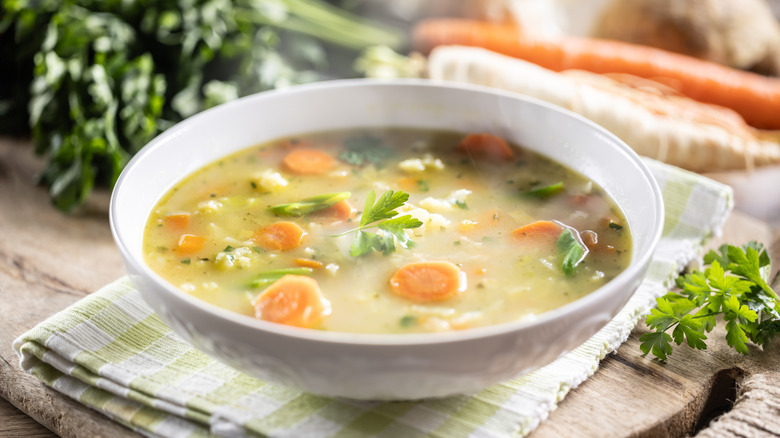
Adding veggies to a soup is a sure-fire way to boost its nutrient profile, as well as adding delicious flavors and satisfying textures. But there are many common soup-making mistakes, and overcooking your veggies into mush is one. To find out the best strategy for adding vegetables into soup, Food Republic spoke with David Davidov, recipe developer and founder of The Cooking Foodie.
The concept of boiling vegetables is simple. When added to boiling water (or stock), the heat causes the cell walls of the vegetables to break down. This is what softens them — and makes them blend in harmoniously with the other soup ingredients. However, some vegetables naturally handle boiling better than others. Denser, starchy vegetables like potatoes, carrots, or celery maintain their structure better, so they take longer to soften, according to Davidov. In contrast, more delicate vegetables such as spinach, peas, or zucchini cook quickly and can turn to mush if boiled for too long — this makes them better suited to gentle, quick-heat methods like steaming to preserve their texture and flavor. The type of vegetable you use also affects whether you should start boiling in hot or cold water.
The cooking time of vegetables is especially important to consider when you're making veggie-forward soups like Ina Garten's pesto-enhanced minestrone soup. According to Davidov, "The key is layering: Start with dense vegetables like carrots, celery, or potatoes, then add quicker-cooking vegetables, such as zucchini, cabbage, or spinach, toward the end." This is the logical approach — if you were to add all of them in together, half of the veggies soup would turn to mush before the denser veggies had even gotten a chance to soften.
Other factors to consider when cooking vegetables in soup
"Another important factor is heat control," David Davidov told us. "A gentle simmer keeps vegetables intact, while a rolling boil breaks them down and causes mushiness." For this reason, allow your soup to reach a boil on high heat and then turn to a low simmer before adding your veggies, using a lid to keep things warm.
While some vegetables boil faster than others, their size and shape can also significantly impact how fast they cook. "Smaller cuts cook faster because they expose more surface area," Davidov explained. For instance, while a thick cut of sweet potato would typically work best for slow, even cooking by allowing the center to soften without the exterior breaking apart, small cubes of sweet potato will finish cooking in a fraction of the time. This metric should also factor in to what kind of soup you're making: "Larger chunks of root vegetables work well for long-simmered soups, while thin slices suit quick soups," Davidov added.
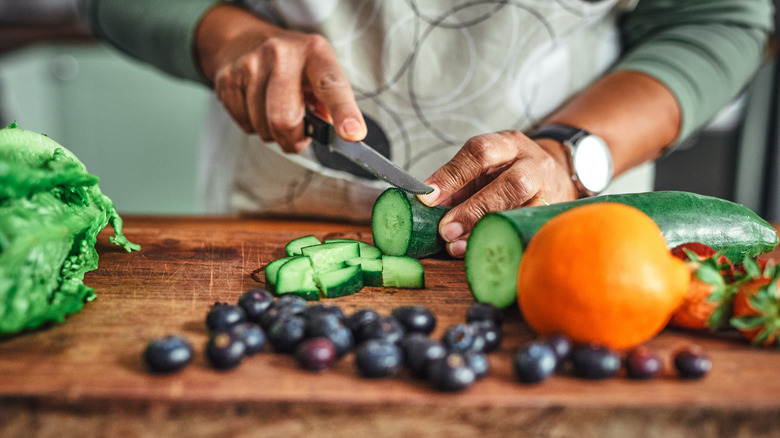
Due to variations in size affecting the cooking time of vegetables, "Uniform cuts are even more important, they cook evenly and prevent some pieces from turning mushy while others stay raw," Davidov told us. The best way to keep vegetables uniform is by using a sharp knife, which allows for more even, controlled slices. For round vegetables like carrots or parsnips, trim them into even, flat-sided shapes before slicing, which will allow you more control and consistency over their shape. Another way to ensure even-sizing is to slice your veggies in batches rather than individually.