
McDonald's French Fries Aren't Dairy-Free
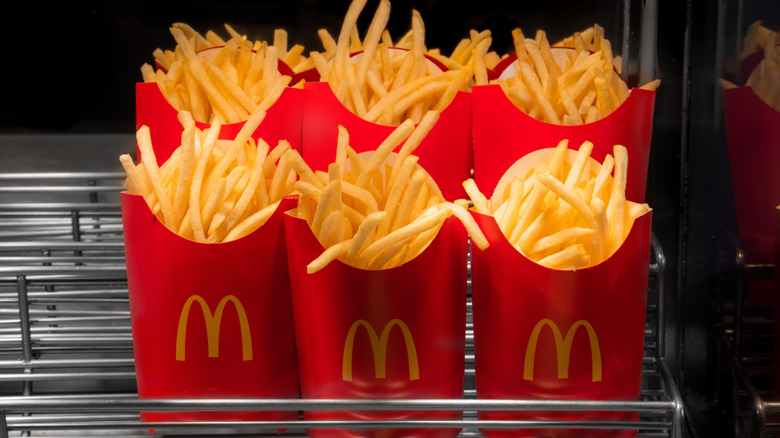
Up there with the Big Mac and McNuggets, McDonald's gloriously greasy fries have achieved legendary status within the fast food world. Their signature slender shape, generous sprinkling of salt, and crisp exterior give way to a soft, fluffy center that has people, quite literally, lining up around the block. Plenty of fans swear they're the best any fast food chain has to offer, and they owe their signature flavor to one rather unexpected ingredient: milk.
That's right, McDonald's fries in the U.S. aren't dairy-free — our condolences to all the vegans out there! Potatoes and vegetable oils make up the bulk of the recipe, but the ingredient list also includes something called "natural beef flavor." Here's where things get interesting — this flavoring contains hydrolyzed wheat and milk. Hydrolysis is a process that uses water to break proteins down into smaller compounds, including peptides and amino acids, which can contribute to flavor. The result is a distinctly savory, beefy note, despite the fries being cooked only in vegetable oil, with no beef fat in sight. The recipe differs across certain locations, too. In the U.K., for example, McDonald's fries contain no animal-derived ingredients and are officially suitable for vegans.
Milk-derived flavoring wasn't always part of the picture. Back in the day, McDonald's cooked its fries in beef tallow, a rendered fat prized for its rich, savory flavor. Tallow can be used in several ways — from baking flaky pie crusts to frying potatoes until they're extra crispy — lending dishes a rich depth that's hard to replicate with vegetable oil alone. But in 1990, amid growing scrutiny over saturated fat, McDonald's made the decision to abandon beef tallow in favor of vegetable oil.
From farm to fryer, how McDonald's fries are made
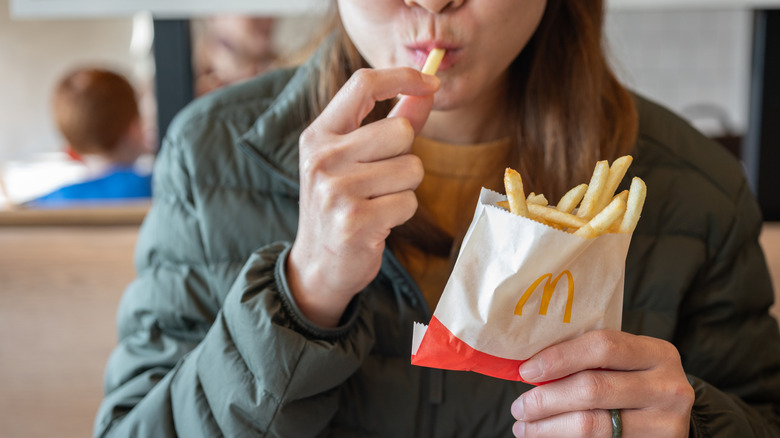
McDonald's fries have been around for a long, long time. The chain was founded in 1940, and fries joined the menu in 1949, less than a decade later. In fact, the cheeseburger is one of the few original menu items that predates them, having been available since the restaurant first opened.
The story of McDonald's fries starts on the potato farm. The chain doesn't rely on a single variety, although Russet Burbank makes up a significant portion of its supply, alongside varieties such as Shepody, Ranger Russet, and Umatilla Russet. An important trait all these potatoes share is their starchiness, characterized by a relatively low moisture content. This combination helps create the fries' signature contrast between a crisp exterior and a fluffy center.
Once harvested, the potatoes head to processing facilities, where the real magic happens. They're cleaned, inspected, peeled, and sliced before being blanched and treated with ingredients that help maintain their familiar appearance. Dextrose helps the fries develop that signature golden hue, while sodium acid pyrophosphate keeps them from turning gray. After drying, the fries are partially fried in oil containing the natural beef flavoring. They're then frozen and shipped to McDonald's restaurants, where they get their final fry before being salted and served hot.