

The Budget-Friendly Cheese Chefs Recommend As A Parmigiano Reggiano Alternative
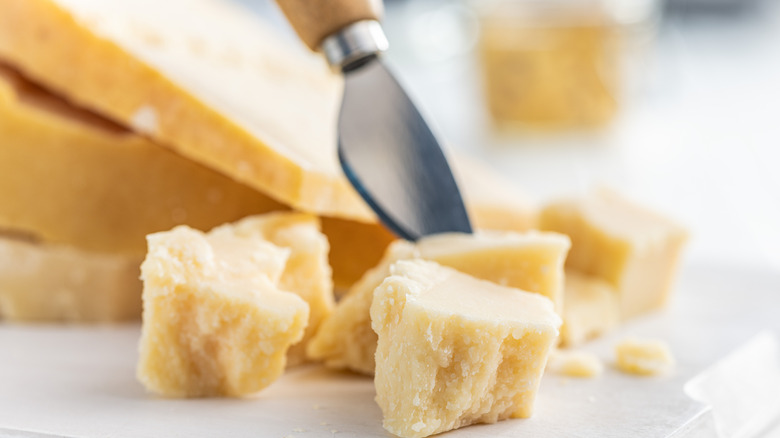
Parmigiano Reggiano and pasta are a match made in heaven: From fettuccine Alfredo to tortellini in brodo, it's hard to think of a pasta dish that isn't completed by a bountiful blizzard of the cheese. The hard cow's milk cheese, made in a small area of northern Italy, wasn't just born to be shaved: It works deliciously on its own or on a cheese board with fruit, nuts, and cured meats. And Americans can't seem to get enough, as imports of Parmigiano Reggiano are growing year over year. But as exquisite and nutritious as it may be, at around $25 per pound at some grocers, it isn't the cheapest of products: cue Grana Padano, its decidedly more budget-friendly and no less worthy alternative.
Parmigiano Reggiano's price isn't coincidental: Unlike imitation "parmesans," the process that goes into making Parmigiano is rigorous and tightly bound by DOP ("Denominazione di Origine Protetta," or "Protected Designation of Origin") rules. It can only be produced in five provinces in northern Italy. Making it is laborious and time-consuming, as it must be aged for at least 12 months and pass inspection by a consortium. Grana Padano, on the other hand, has a wider production area and a minimum aging period of nine months, contributing to its generally lower price tag — typically around $17 to $18 per pound, though prices may vary.
While Grana Padano certainly appeals to the parsimonious shopper, plenty of chefs, including "Top Chef" alum Fabio Viviani, actively vouch for it. "I prefer it over other sharper, more aged cheeses like [Parmigiano] because it blends better with other ingredients," he said (via FSR Magazine). Plus, with over 5 million wheels produced annually under its own PDO protection, it stands as a globally beloved cheese in its own right.
Softer feed rules give Grana Padano a butterier profile
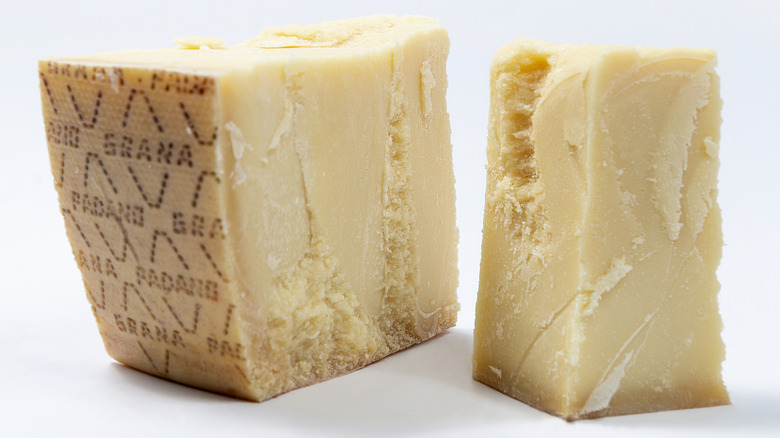
To the unsuspecting eye, Grana Padano might even pass for Parmigiano Reggiano — wheel-shaped, granular, and with a similarly earthy, nutty profile — but it's a distinct cheese with its own production process, texture, and flavor. And don't be fooled by the lower price — it's an excellent product that can sometimes work even better than your classic Parmigiano.
While Parmigiano's grainy texture and slightly tangy aftertaste — partly a result of its longer aging — might not be to everyone's liking, Grana is noticeably milder and almost butterier, with a smoother mouthfeel and crumble. The subtle flavor differences are also owed to what goes into the cheesemaking — or, more specifically, what the cows eat. The cattle whose milk is used to make Grana are allowed to eat silage, a fermented type of forage, unlike those whose milk is used for Parmigiano, which are fed hay and fresh grass. This difference, along with Grana's shorter minimum aging period, helps create its more delicate texture.