

Why Navy Sailors Never Wash Their Coffee Cups
The Navy is full of interesting, age-old traditions that might sound slightly odd to the everyday citizen. From the famous crossing the line ceremony to fool's errand initiation tasks, there's a lot more going on behind the scenes than meets the eye. Another unique quirk of sailors involves their coffee cups. Let's just say, if you ever find yourself having a bite to eat on a naval submarine, we recommend coming equipped with your own coffee mug.
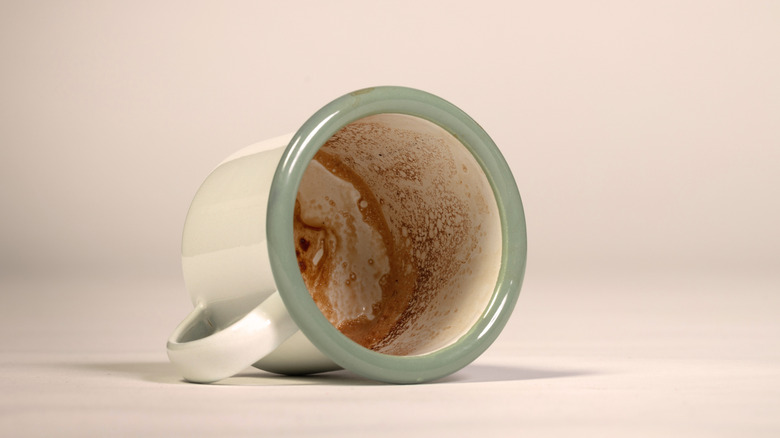
Throughout thousands of years of maritime history, one constant is that sailors, whether naval admiral or rogue pirate, are a superstitious bunch. So superstitious, in fact, that washing their coffee cups has become a serious taboo within the Navy. Sailors, including senior personnel and chiefs, sometimes refuse to wash their mugs because the accumulated stains from coffee's natural tannins act as a badge of seniority or status. Seriously, there are even tips out there guiding sailors on how to quickly achieve a perfectly stained coffee mug. The dirty cup has become something of their own visual calendar; the darker the mug, the longer a sailor has served, establishing a clear line of hierarchy and accumulated memories.
Many sailors believe cleaning a "seasoned" mug brings bad luck, as it quite literally washes away the hard work and time tied to their deployments. It's taken so seriously that scrubbing someone else's cup, even with scurvy-busting lime, is considered a severe social infraction, and the easy way to immediately land on somebody's bad side. This quirk might sound off-putting to the ordinary citizen, but allegedly, not washing the cup allows the oils to build up to the point where the mug develops a permanent patina, which some sailors swear improves the taste of their morning brew.
Coffee has always played an important role within the Navy
Many romanticize a life on the open ocean, far removed from the troubles of land, but the reality of the seven seas is far from easy. Paired with the demands of active service, it's easy to see why coffee has become such a pillar aboard Navy ships. For as long as American naval history has existed, coffee has been there too.
In fact, coffee is so tied to the Navy that the classic phrase "cup of Joe" is popularly traced back to naval lore. In 1914, Secretary of the Navy Josephus Daniels issued General Order No. 99, banning alcohol aboard Navy ships, ending what had long been sailors' drink of choice. As the story goes, the sailors, none too pleased with the unpopular order, started referring to their coffee ration as a "cup of Josephus," a tongue-in-cheek jab. While it's a great piece of trivia to whip out at a pub quiz, many etymologists are skeptical. Some linguists instead trace "joe" back to "jamoke," old naval slang combining java and mocha, coffee's two most famous growing regions. Others claim it's got nothing to do with the Navy at all.
But the Navy's connection to coffee goes much deeper than naming folklore, and perhaps its biggest chapter came during World War II. According to History, nearly 10% of all U.S. coffee imports were dedicated to the armed forces, so the troops could be caffeinated despite shortages. At the time, the U.S. Navy wasn't only drinking heaps of coffee; it was producing it too. The Navy established its own coffee-roasting plants in Brooklyn, New York, Oakland, California, and Hawaii, home to prized Kona coffee. The wartime coffee wasn't known for its artisanal taste, and almost ironically, salt was often added to counteract its bitterness.