

Why Keurig's Coffee Pod Inventor Regrets His Creation
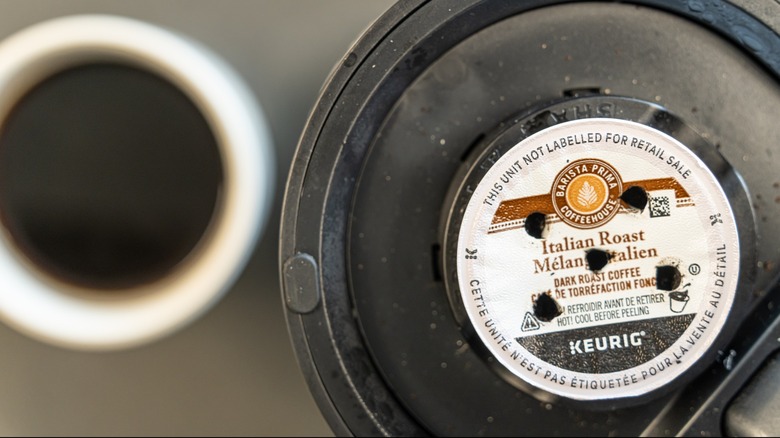
There's not much we can knock about coffee pods. Sure, they're not on the same level as freshly brewed grounds, but they're unmatched for quick convenience and affordability. Sitting in the same ranks as Nespresso and Illy is Keurig, the company behind the hugely popular K-Cup. Keurig has no shortage of admirers, but one person who isn't among them is John Sylvan, the man who actually invented the K-Cup.
Looking for an alternative to mass-produced office coffee, Sylvan came up with the K-Cup, which officially launched in 1998. The concept was rooted in simplicity: Paired with a compatible Keurig machine, the cup gets pierced, hot water gets pushed through the grounds, and a single cup of coffee comes out in under a minute. What's not to love, right? Well, according to Sylvan, plenty. In a 2015 interview with The Atlantic, he didn't hold back: "[The pod is] like a cigarette for coffee, a single-serve delivery mechanism designed for an addictive substance."
Sylvan's real issue with the K-Cup is that it became exactly what he set out to avoid. He'd hoped to give office workers a cheaper, faster alternative to a Starbucks run, something that would cut down on daily coffee cup waste. However, around the time of the interview, Keurig told The Atlantic it sold a staggering 9.8 billion coffee pods in just a single year; what it failed to mention was that the majority of them end up in landfills. That, more than anything else, is what haunts Sylvan. "I feel bad sometimes that I ever did it," he said. He's since sold his stake in the company and doesn't even own a Keurig himself.
K-Cup pods face persistent recycling and waste disposal hurdles
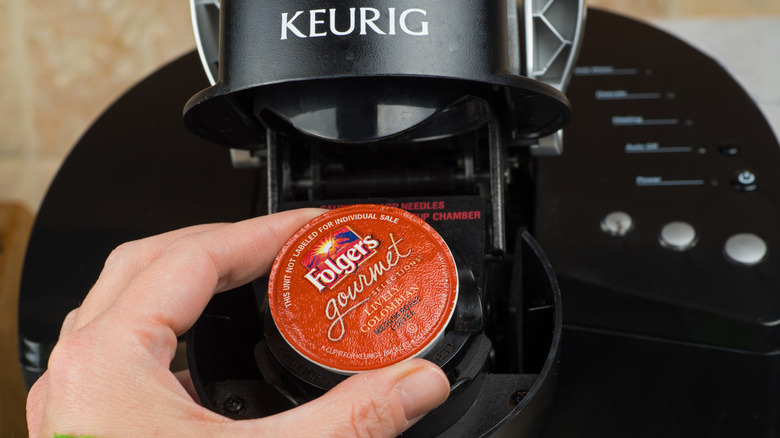
John Sylvan is a man truly suffering from success. He never anticipated the astronomical popularity of K-Cups, and while Keurig certainly built a faster way to brew, it also built a machine churning out billions of pieces of plastic a year. The problem? Many of them aren't recycled — a common complaint among customers.
"No matter what [Keurig says] about recycling, those [pods] will never be recyclable," Sylvan told The Atlantic. At the time, Keurig was using No. 7 plastic, a mix accepted by few recycling facilities. In 2020, the company switched its pods to polypropylene, or No. 5 plastic, a genuinely more recyclable material. But issues still persisted. In 2024, the U.S. Securities and Exchange Commission charged Keurig $1.5 million for overselling that very claim, as some major recycling companies still don't accept this type of plastic.
Some pod manufacturers, taking a page from Nespresso's book, have started making compatible pods from aluminum instead, which recycling facilities can process far more easily. But that only solves half the problem. Even when a pod makes it to said facilities, its tiny size makes it nearly impossible to separate from everything else, so it often ends up in a landfill anyway. To make matters worse, K-Cups aren't exactly easy to recycle at home. Their mixed-material components have to be manually separated for processing. On the bright side, though, for those looking to (conveniently) reduce their environmental footprint, there are plenty of creative ways to repurpose used coffee pods.