

Forget Boring Hot Dogs – Make Them Danish-Style
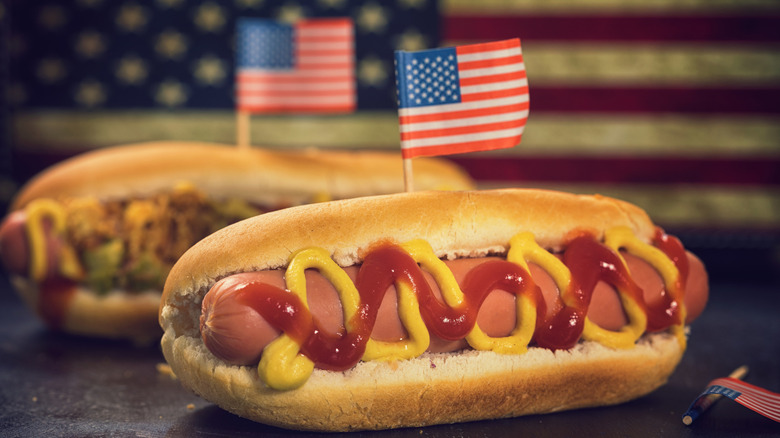
Whether you're tailgating at a baseball game or looking for a quick road trip pick-me-up from a gas station, hot dogs are the ultimate on-the-go bite. Part of their charm is how uncomplicated they are, but venture outside the USA, and you'll find plenty of other countries with a totally different philosophy of what makes a great hot dog. One particularly appetizing version that caught our attention was the Danish-style hot dog, known as pølse, which layers sweet, salty, and smoky flavors for a bite unlike anything you'll find at a Fourth of July cookout.
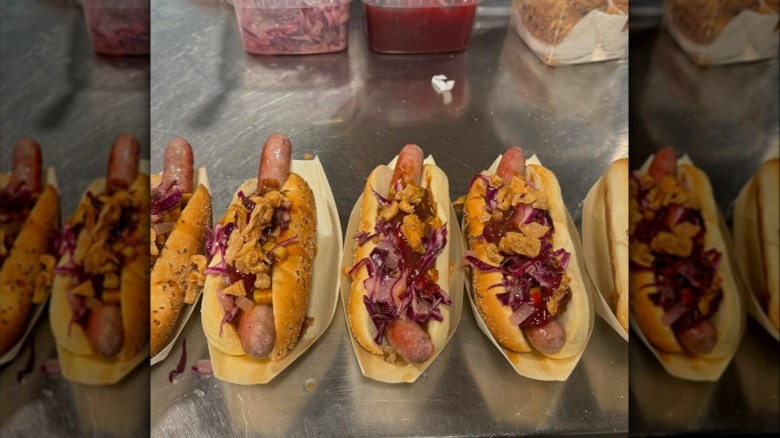
To unpack the differences, you've got to start with the most important part of any hot dog: the sausage. American hot dogs are typically made from an emulsified blend of various meats ground down into a smooth paste. Denmark takes a slightly different approach. While it also employs an emulsified blend of meat, its dogs are almost exclusively made using ground pork. Known as rød pølse – literally meaning red sausage — it gets its name from its striking color derived from bright red carmine dye. Then there's ristet pølse, a grilled take on the same sausage, browned over heat and wrapped in natural casing that gives it a satisfying snap with every bite.
If the U.S. hot dog is a masterclass in simplicity, the Danish version sits on the total opposite end of the spectrum. The star of the show is the remoulade, a tangy, mustard-forward mayo paired with bright ingredients like pickles, capers, shallots, and even a hint of curry powder. From there, it's layered with crisp raw onions for crunch and sweet pickled cucumbers for acidity. Like its U.S. counterpart, it's also not uncommon for ketchup and yellow mustard to be slathered on top.
How did hot dogs become so popular in Denmark?
We can't emphasize enough how hugely popular hot dogs are in Denmark. To put it into perspective, many Danes even regard the sausage as one of the nation's national dishes outright. It all started with the pølsevogn carts, which hit the streets of Copenhagen on January 18, 1921. At these early hot dog carts, you could buy pølse, which could be paired with bread for an added price. They were an instant hit, and in the 1960s and '70s, Denmark had more than 700 of these mobile hot dog stands in operation all over the country.
Enjoyed by both rich and poor, they became more than just a food stand, representing a unique symbol of equality in public spaces. While their numbers have thinned out in the 21st century, the loyal fanbase hasn't, and every pølsevogn is usually accompanied by a long line. In 2025, members of the public even pushed to have the pølsevogn recognized as part of the country's UNESCO intangible cultural heritage.
While the story of the pølsevogn carts is an incredibly wholesome one, the same can't be said for the legends of how the rød pølse got its distinctive red hue. One common theory from back in the day is that hot dog vendors would dye the sausages red to cover up any signs of spoilage or poor-quality meat. Another conflicting (and less disgusting) speculation is that the red dye was used to warn customers that the sausages were not freshly made that day. But fact or folklore, the red color has stuck around, and you'll have a hard time finding any pølsevogn cart that doesn't offer rød pølse.