

Stop Refrigerator Grease And Odor Buildup Before It Starts With One Thing

Ever opened your fridge door and gotten smacked with a foul odor out of nowhere? You're not alone. Grease and odor buildup are an occupational hazard of refrigeration, but the good news is that they're entirely preventable. Enter one of the quirkiest, most satisfying kitchen hacks out there: the dynamic duo of baking soda and lemon.
Things like spoiling food and spilled sauces attract bacteria, which moves in to break them down while releasing stinky gases in the process. Grease, on the other hand, often comes from outside your refrigerator. Cooking with oil releases microscopic droplets that float around in the air. When you open your refrigerator door, these particles can get sucked in and settle on the walls and trays. The problem is that oils solidify when exposed to cold temperatures, which over time can form a tacky buildup that's as ugly as it is stubborn to remove. This is where baking soda comes in clutch. It acts as a natural odor absorber, neutralizing bad smells instead of just covering them up. This can all be explained by science: Chemically speaking, baking soda is a base, while the odor-causing particles are acidic. Base molecules are drawn to acidic molecules, and when they meet, they react and neutralize each other.
To store the baking soda neatly, grab a lemon. Simply slice one in half, scoop out the contents, and you've got the perfect, natural bowl. The lemon's rind and juice being citric acid to the mix, and beyond its natural aroma keeping the fridge smelling fresh, you can use the leftover pulp to help break down grease buildup. You'll need to replace the lemon halves every one to two weeks, since the rind dries out and loses its punch over time.
More ways to keep your refrigerator looking and smelling fresh
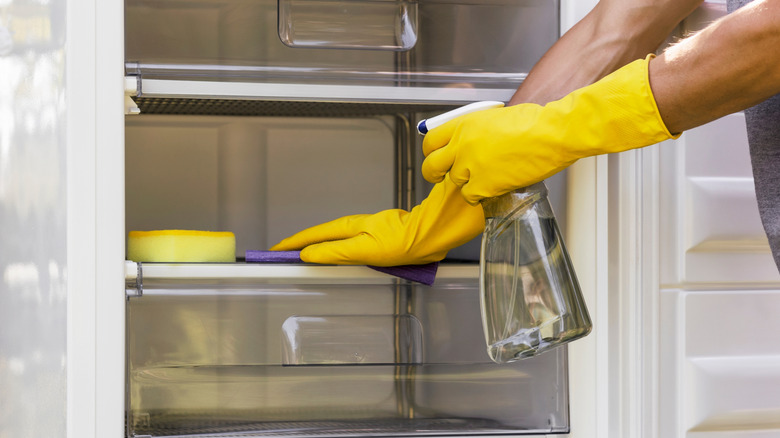
Baking soda is one of the most versatile kitchen cleaners out there. But it's by no means the only way to keep your refrigerator looking and smelling fresh. Right on the other end of the color spectrum is activated charcoal, a carbon-based material that's been treated to develop millions of tiny pores across its surface. Those pores dramatically increase its surface area, giving it a sponge-like ability to trap oil and odor molecules floating in the air. Coffee grounds are also known to eliminate kitchen odors due to their high nitrogen content which, like baking soda, neutralize odor-emitting molecules.
But beyond using baking soda, activated charcoal, or coffee grounds to tackle grease and odor buildup, there are plenty of practical habits that can prevent them from happening in the first place. Simple steps like placing food in an air-tight container, wiping up spills right away, and labelling items with use-by dates can all help keep smells and stickiness under control. It's also worth occasionally checking your drip pan, since it can quietly collect moisture and mold if ignored. Another simple yet effective tip is to avoid overpacking your fridge. A crowded fridge can prevent even air-circulation, which can cause pockets of odors to linger despite no spoiled food.
While you don't need to deep clean your fridge weekly, a quick wipe-down of shelves and surfaces every week or two will stop grease before it ever gets the chance to set in. If you find yourself up against particularly stubborn stains, a paste of baking soda and water, paired with an acid like lemon juice or white vinegar, will work wonders for lifting even the toughest of stains.