

How To Drink Vodka Like You're In Russia
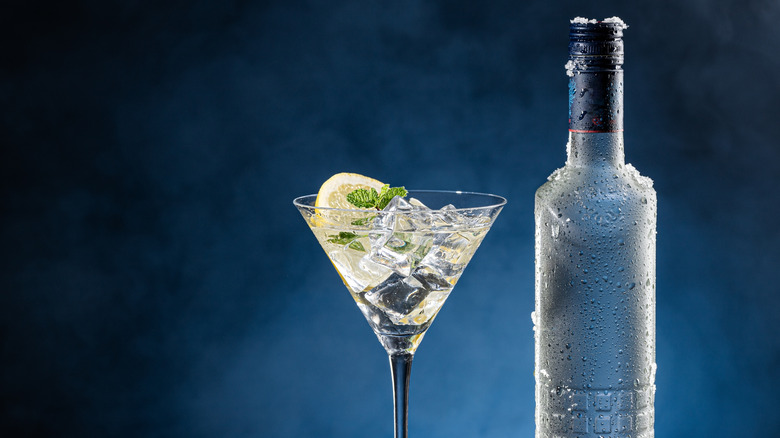
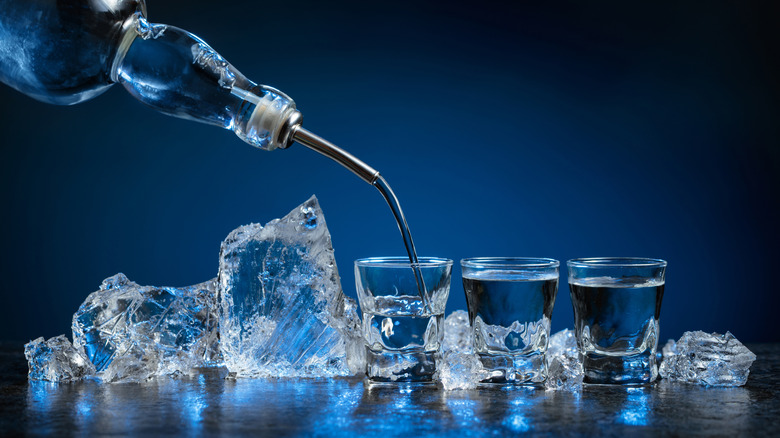
Some countries have food and drinks that are inalienably tied into their national identity. Think of the United Kingdom and fish and chips, or how apple pie has become a symbol of old-school Americana. Over in Russia, it should come as no surprise that vodka occupies that same iconic status, and despite not being the world's largest exporter, for centuries the spirit has been woven into Russian culture, celebrations, and social life. In the States, we tend to approach it as a party shot or cocktail mixer. Russians, however, do things a bit differently. Traditionally, vodka is served chilled, drunk in a single gulp from a shot glass, and almost always accompanied by local snack foods.
Contrary to popular belief, most Russian vodka isn't made from potatoes. Instead, it's typically produced from grains such as wheat or rye. The grain is first fermented, then distilled multiple times to create a highly purified spirit. After distillation, the alcohol is diluted to bottling strength using exceptionally pure water, with some premium brands boasting glacial water as part of their recipe. Many vodkas are then filtered, often through activated charcoal, to remove impurities and create a clean, crisp taste.
To drink vodka like a Russian, you'll first need to gather company. The custom of communal drinking dates all the way back to the Soviet Union, where Soviets often pooled their money to buy and share a bottle of vodka — also known soobrazitnatroikh ("think for three"). Alongside company, food is also essential. Think classic Russian picnic-bites (locally known as zakuski) like pickles, cured herring, or dark bread, which are commonly enjoyed after the shot to mellow the burn of the spirit. To further mask the harsh alcohol taste, always ensure the bottle is chilled — but never frozen.
How did vodka become such a classic Russian drink?
Distilled spirits arrived in Russia toward the end of the 14th century, when ambassadors from the Republic of Genoa introduced a grape-based spirit known in Latin as aqua vitae, or "water of life." Like many early European spirits, it was initially valued as much for its perceived medicinal properties as it was for drinking.
It didn't take long for Russians to adapt the method of using ingredients that were more readily available. Using grains, they produced an early vodka precursor known as "bread wine." Over the following centuries, this grain-based drink gradually evolved into the vodka that would become synonymous with Russia. Despite both Poland and Russia claiming to have invented the spirit, Russia can undoubtedly be credited for many of its most important innovations. In 1780, Russian scientist Theodore Lowitz invented charcoal filtration to give vodka a famously smooth taste, odorless profile, and clean mouthfeel. Then, in 1894, Tsar Alexander III and scientist Dmitri Mendeleev established the standard that vodka should be exactly 40% alcohol by volume (ABV) to keep the profile of the spirit smooth without diluting its flavor. To this day, 40% ABV remains the gold-standard proof for vodka in many countries.
During World War I, Russia introduced a nationwide prohibition on alcohol, which remained in place through the Russian Revolution and the early years of the Soviet Union. It wasn't until 1924, under Joseph Stalin's leadership, that the ban was officially lifted. This turbulent period of Russian history prompted many Russians to emigrate, taking their vodka-making traditions with them. Fueled in part by the establishment of the iconic Smirnoff brand and the invention of the fashionable Moscow mule, vodka (slowly) became popularized within the U.S., cementing the spirit's enduring association with Russia.