

Monster Vs Coffee: Which Energy-Boosting Drink Has More Caffeine?
For many of us, mornings and afternoons call for caffeine, a much-needed jolt to get the day going. Yet precisely how we ingest this compound varies. Coffee may be the most famous vessel, but caffeine comes from a wide array of sources, ranging from chocolate and tea to energy drinks.
Untangling which beverage packs the bigger buzz is complicated; take Monster versus coffee, for example. By its name alone, the energy drink alludes to strength. Crack open a can, and you'll definitely feel something: A 500-milliliter can of the original Green contains 160 milligrams of caffeine. Meanwhile, 16 ounces of brewed coffee offers 192 milligrams of caffeine, making it the stronger drink ounce for ounce.
Still, there's more to consider. Some Monster flavors offer more caffeine, while some coffee beverages offer less. A cup of joe can refer to a broad range of serving sizes, not to mention Monster features several other energy-boosting compounds in the mix. Calculating caffeine is a tricky endeavor, and many factors come into play.
Monster offers predictable caffeine levels and a unique energy blend
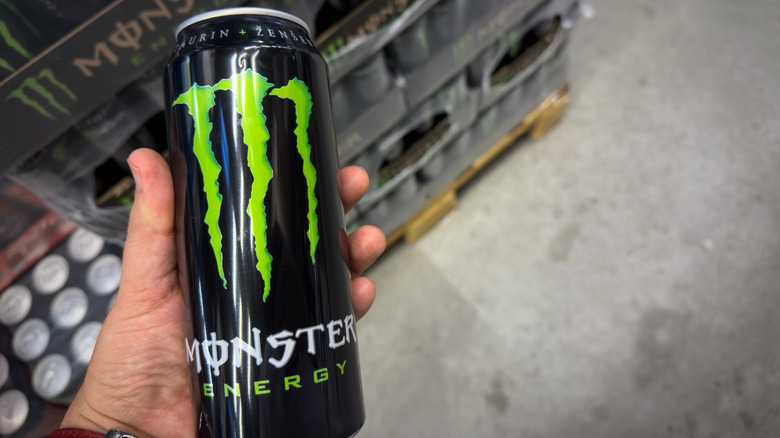
As a manufactured product, Monster's caffeine content is no accident. As a result, it falls right in line with many commercially available coffee beverages. A medium Dunkin' iced latte contains 166 milligrams of caffeine. Meanwhile, a Rio Punch Monster contains 160 milligrams.
The brand is available in varying serving sizes, as well as different flavors, which do affect the amount of caffeine. A Monster Ultra Zero, for example, offers a slightly lower 150 milligrams, while Killer Brew climbs to about 300 milligrams. Overall, Monster occupies a similar, if not slightly lower, range than coffee. Unlike a cup of joe, you can easily find the caffeine content printed on the can.
Take note that Monster comes with other energizing compounds, too. The drink uses additives like inositol, which helps convert nutrients into energy, as well as L-carnitine, which also plays a part in energy metabolism. Assessing how much these additions contribute to stimulation is difficult, but they likely kick Monster's invigorating effects up a notch. Not to mention, a 16-ounce can of Green Monster has 54 grams of sugar, which further intensifies the rush. Such a composition makes Monster a distinct drink from coffee, with any jitters taking on a different form.
Coffee makes it easy to caffeinate
Like Monster, coffee comes in many shapes and sizes, whether as a chilled cup of iced coffee, cold brew, nitro, or a hot mug. Based on your consumption ritual, the caffeine content varies widely. A single shot of espresso can come in as low as 63 milligrams. Meanwhile, 16 fluid ounces of Starbucks Nitro Cold Brew contains 280 milligrams. More often than not, coffee beats out a classic Monster drop for drop, but the dosage is highly variable.
After all, many coffee drinkers opt for several cups, as opposed to Monster's one-and-done convenience. If your daily habit involves two espresso-based beverages, traditionally made with a double shot each, that's approximately 256 milligrams of caffeine. To further complicate matters, caffeine content varies by coffee bean, too. Robusta beans deliver a bigger kick than arabica, for example, with approximately twice as much caffeine. Compared with Monster, predicting the caffeine content of coffee isn't easy.
Generally, drink a cold brew or one or two large drip coffees, and you're likely exceeding the canned drink. Stick to a small brewed serving, and Monster will win out. Whichever one you go for, you'll certainly get your fix.