

Why Alton Brown Refuses To Eat This Mollusk

Alton Brown rose to fame as the host of Food Network's "Good Eats," winning viewers with its blend of food science, history, and culinary technique, all presented in his quirkily entertaining style. Despite cheerleading all kinds of food on his Peabody Award-winning show, Brown isn't shy about talking about what he doesn't like. He's posted on X, for instance, that truffle oil "sucks," and has said that it's impossible to make calf liver taste good. But the reason he won't eat one particular mollusk has nothing to do with its flavor. Instead, he explained on the YouTube channel "Mythical Kitchen" that he won't eat octopus after an experience with one that left him profoundly moved. Essentially, one mollusk remembered him from a previous encounter and forever changed his perspective on eating them.
Animal intelligence is assessed using a variety of behavioral and neurological measures, and octopuses are considered among the most intelligent invertebrates. They have relatively large and complex nervous systems for invertebrates, and some species possess larger brain-to-body ratios than certain vertebrates. The animals are also able to solve puzzles, overcome obstacles, and use tools, and as Brown discovered, they do remember things. The suction cups on octopuses' eight arms have chemical sensors that can smell and taste, which likely played a major role in how the one he'd met before remembered him. Sight may have also been a factor, as octopuses are able to visually recognize humans.
Many cultures enjoy octopus through varied culinary techniques
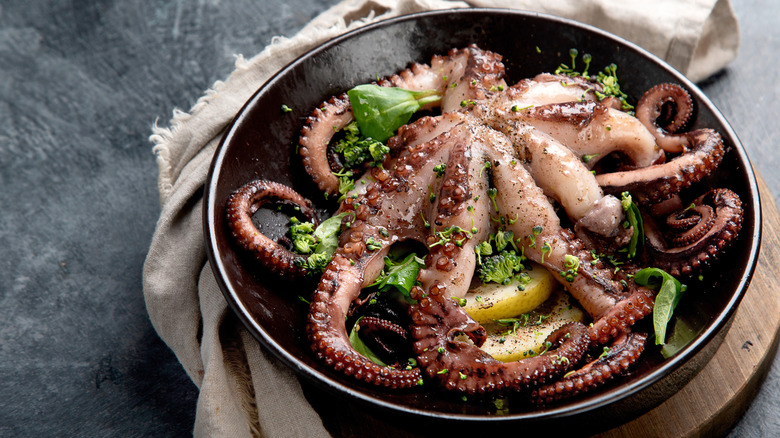
Even though Alton Brown has made his stance clear, millions of people around the world enjoy eating octopus. It's particularly popular in Mediterranean countries such as Spain, Italy, Portugal, and Greece; Asian nations including Japan, Korea, and China; and even Mexico.
One of the most traditional octopus dishes is Spain's pulpo a la gallega, which consists of octopus dressed with olive oil, paprika, and salt. In Italy's polpo alla Luciana, the mollusk is stewed in a tomato sauce made with garlic, olives, and capers. Octopus is commonly found in sushi in Japan, and it also stars in a favorite street food called takoyaki. The round fritters are made with pieces of octopus in a flour-and-egg batter that includes soy sauce, ginger, and dashi, a Japanese stock rich in umami flavor.
If you're cooking octopus at home, the most challenging part can be transforming its rubbery texture into something tender. There's a traditional Italian myth that cooking it with wine corks helps, but a better approach is probably to simmer it for about an hour, or use a pressure cooker to reduce the cooking time. Adding a little vinegar to the cooking water can also help tenderize the meat, as can soaking it in whole milk overnight. For the best results, it's helpful to complete this process before moving on to other preparations, such as grilling, pan-searing, or roasting. You could also fry the tentacles, cut the octopus into pieces and mix it with other seafood in a pasta sauce, or refrigerate it and serve it cold in a salad.