

Budweiser's Beer Label Has Hidden Meanings. Let Us Explain
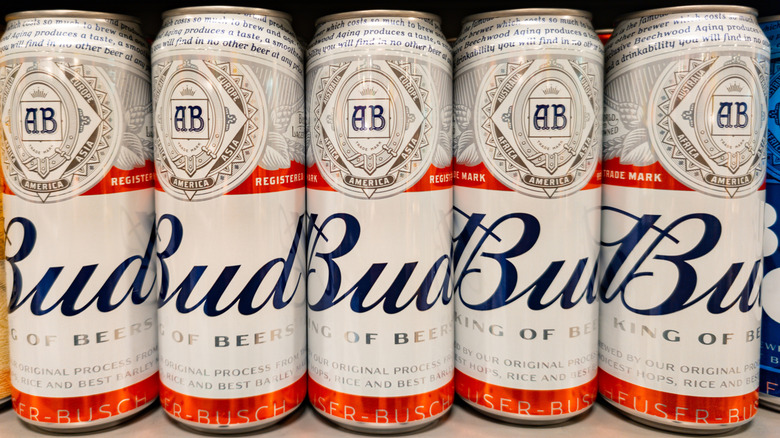
Whether it's Jack Daniel's' square bottles or Jägermeister's famed deer logo, packaging plays a major role in alcohol marketing. Such immediate discernibility applies to beers, too. Take Budweiser's recognizable red-and-white aesthetic, for example. Crack open one of these cold ones, and it's all too easy to skip over the abundant label details that are full of hidden meanings that reflect the brand's storied history.
Right upon the beer's 1876 debut, early bottle design was simple, bearing a plain "Original Budweiser" engraving. Over the years, the appearance turned increasingly ornate, with added decoration translating further meaning. In 1886, a label was first registered, featuring the earliest version of the iconic banner. Joined by abundant cursive writing, much of this text was originally in German. The language — as well as the Budweiser name — serve as an ode to the Czech town of České Budějovice (called Budweis by local German speakers). Since the beer arose as an imitation of Czech Bohemian-style pilsners and lagers, Budweiser includes several references to the area.
Conversely, two eagle etchings — or occasionally a single, larger bird on anniversary cans — reflect American pride. Furthermore, the AB initials (short for Anheuser-Busch) also quickly imprinted on the front of the beer label. To this day, you can inspect closely around the lettering and find barley and wheat, the brew's foundational ingredients. Finally, "King of Beers" appeared on the label in the mid-20th century, another hint at the brew's European royal inspiration.
The evolution of the Budweiser beer label
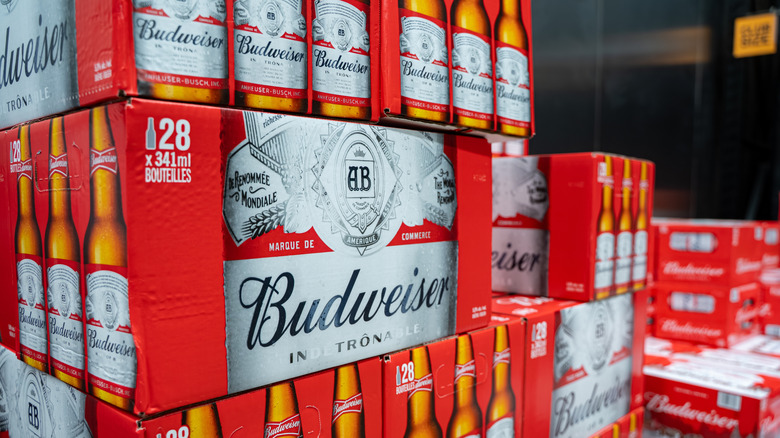
Although not the oldest brewery in the United States (an honor that belongs to Yuengling), Budweiser nevertheless prominently shaped American beer history. When the lager debuted in 1876, it was solely bottled from the start — a rarity for beer of the period. Anheuser-Busch was also an American pioneer in pasteurization, enabling widespread distribution. Subsequently, a distinguishable container proved extra important, hence the elaborate label. For the first few decades, Budweiser sold the beer in glass, until can packaging started in 1936.
In this post-Prohibition period, Budweiser experienced rapid economic growth, in no small part due to marketing. The company often promoted the label's recognition and authenticity. Such initiatives explain markers like "genuine" (spotted sideways at the top of some cans), as well as the extended writing atop the can that reads "This is the famous Budweiser beer...". The company has trialed other details, too; Budweiser once featured a multi-colored logo, and the bowtie has increasingly appeared in branding since 1956. All backed by a storied history, the Budweiser package contains a remarkable story.