

Here's Why Walmart's Ice Cream Sandwiches Don't Seem To Melt
We may receive a commission on purchases made from links.
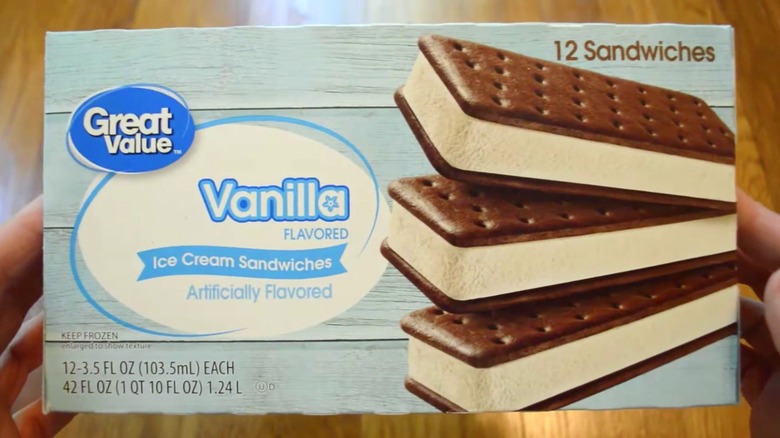
In an era saturated with processed ingredients, food durability often receives skepticism. There's the circulated myth that a Twinkie's shelf life extends forever, when in actuality it is closer to 25 to 45 days. Similarly, while critics claim a McDonald's burger won't rot, this phenomenon occurs only under specific conditions of rapid dehydration. In a similar vein, customers cite that Walmart's Great Value Ice Cream Sandwiches don't seem to melt, which is quite an unusual observation for a frozen treat.
"I left this out all night last night on the counter ... nothing has changed. This is not ice cream," one TikTok poster stated. "I decided to cut my ice cream sandwich in half and let it sit [at] room temp. The inner layer [melted] like any other ice cream but the outer layer did not," a Reddit user wrote. The degree of melting varies per report, but it's clear that the ice cream bar packs unusual thawing qualities — what's behind that?
Turns out, it's by way of stabilizers and air. As noted on the product's ingredient list, the ice cream contains quantities of mono and diglycerides, carob bean gum, carrageenan, and cellulose gum. All such components function as textural stabilizers, designed to both prevent runny ice cream and maintain the sweet's consistency. Subsequently, additives halt the loss of shape, especially when used in specific formulations.
Furthermore, Walmart's ice cream comes with a relatively low fat content and high amount of stabilizers, which helps the ice cream hold its form even as the ice crystals melt. Together, these ingredients create an ice cream bar that remains solid in appearance even long after being removed from the freezer.
Great Value ice cream sandwiches contain no unusual ingredients
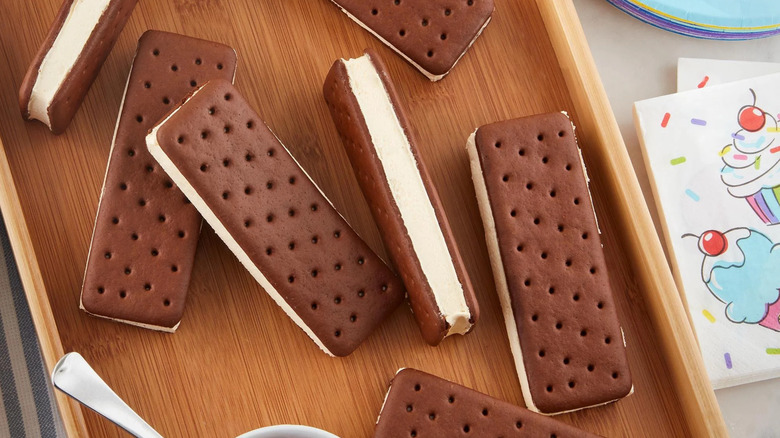
Whether it's setting out Walmart's ice cream in the sun or zapping it in the microwave, the internet is keen to showcase the frozen treat's unusual consistency. Yet despite the abundant skepticism, the retailer's recipe doesn't stray far from the industry norm for "economy" frozen desserts. The use of gum stabilizers in frozen treats is widespread; you'll often find this additive category on many store-bought ice cream ingredient labels.
For instance, carrageenan — which is extracted from seaweed, and is responsible for the odd texture of Taco Bell's steak — also appears in some Ben and Jerry's flavors, while carob bean gum — derived from carob tree seeds — is employed in certain Tillamook ice cream products. Cellulose gum is a frequent addition to vegan dessert recipes, designed to thicken consistency. The gum additives found in Walmart's Great Value brand receive a "generally recognized as safe" (GRAS) label from the FDA, making the ice cream less dangerous than some internet chatter may suggest.
That being said, Walmart's Great Value frozen treat does use a greater variety of thickeners than other brands, which lends it a perceptibly sticky texture even when warm. It's not a quality you'll find in premium ice cream brands like Häagen-Dazs — even though customers think its beloved ice cream bar has gotten worse — but it's nonetheless not worth losing your cool over.