

Turn Yellow Mustard Into Your Own DIY Dijon With A Few Pantry Ingredients
We may receive a commission on purchases made from links.
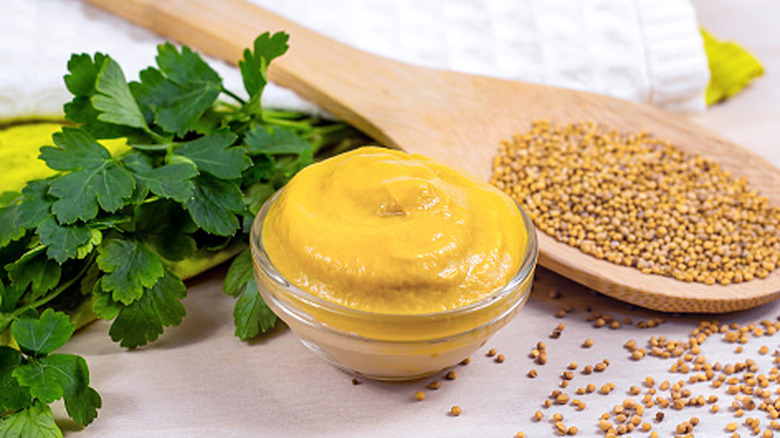
If you were to open your refrigerator right now, it's likely you'd find a bottle of mustard inside. You might even have more than one type of the common condiment, which might be older than the others, as it takes time for mustard to eventually go bad. But sometimes a recipe may call for a particular kind you don't have, or you're out of one you want to use. If it's Dijon mustard you need, instead of running to the store, you can make a DIY imitation with yellow mustard and some familiar items from your pantry.
Mix yellow mustard with a little white wine vinegar to help reproduce Dijon's traditional tang, along with sugar, water, and salt to taste. Since Dijon is spicy, you could also include a bit of horseradish or wasabi to add some flavorful heat. You could also try substituting a spicy brown brand like Gulden's. It has a comparable, but stronger, taste, so add a small amount of water to make it a little less assertive, or reduce the amount if you're cooking with it.
You can use your replicated Dijon in the same way you would the original. In addition to fancying up sandwiches and hot dogs, it can be included in marinades, vinaigrettes, pan sauces, or slathered on meats, poultry, or fish in breaded dishes for the breadcrumbs to cling to. It also often appears in American favorites like deviled eggs and potato salad, and can upgrade boxed mac and cheese.
The history of Dijon mustard
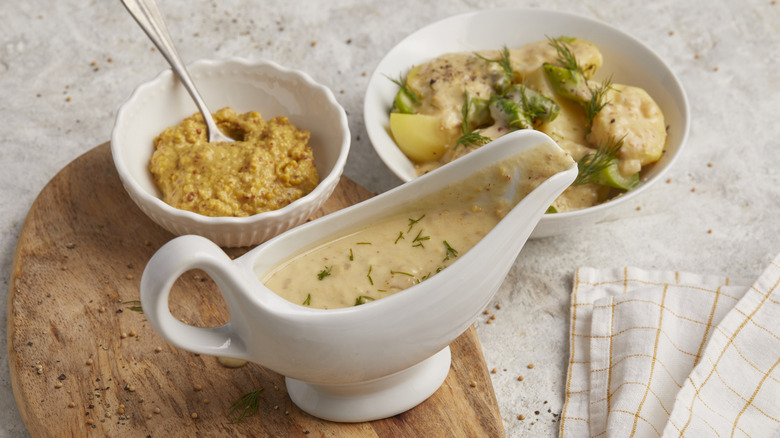
The origin of Dijon mustard can be traced to the 13th century, in the same-named French city in Burgundy that at one time was a center of the condiment's production. It was first regulated in the late 14th century, and by 1870, there were some dozens of producers making it — although there are now just four left in the city (per the Dijon Tourist Office).
The condiment is made from the seeds of mustard plants. Yellow mustard is produced with the milder yellow ones, while brown and black seeds create more heat and are used for spicier types. To make Dijon, brown or black seeds are traditionally soaked in water, and then ground and mixed with white wine, white wine vinegar, and salt. In the 19th century, mustard-makers in Dijon started using verjuice (or "verjus"), unripe grape juice, instead of vinegar; however, most brands now use vinegar. The seeds' dark skins are filtered out, leaving the creamy, light yellow condiment.
Likely the most well-known Dijon in the U.S. is Grey Poupon, now owned by Kraft Heinz, made with the same recipe that goes back to 1777 in the French city. A big reason for its fame is a classic 1980s TV commercial that cheekily portrayed it as high-class. In it, a chauffeured Rolls-Royce pulls up next to another, and the passenger in the back of one rolls down the window and asks the person being driven in the other car in what became a famous catchphrase: "Pardon me, would you have any Grey Poupon?"