

The Price Of A Burger King Whopper Was Shockingly Low In 1957 Compared To Today
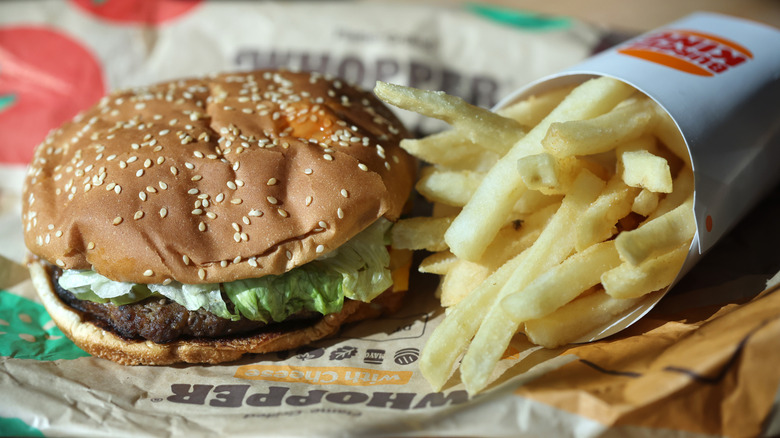
Burger King's iconic Whopper has been through many transitions since its 1957 debut, including some outrageous versions of the burger the chain has rolled out over the years (the infamous Halloween 2015 Whopper with its black bun comes to mind). One significant change has been the Whopper's price journey since it first rolled out. As of March 2026, a standalone original Whopper (sans drink or fries) starts in the $5 range at the low end and runs up to more than $10 per sandwich, depending on where you live. That's a far cry from the sammie's original price, which was, amazingly, just $0.37 when it first rolled off the grill.
The value of a dollar has certainly changed over the decades since Burger King first put flame to burger. To help put things in perspective, the median cost of a new home in the United States in 1960 was $11,900 (per U.S. Census). As of January 2026, that had increased more than thirtyfold to a whopping (no pun intended) $400,500. As with housing, inflation has definitely been unfavorable for fast-food prices. Per the American Institute for Economic Research's Cost of Living Calculator, $0.37 in 1957 would be worth $4.27 in 2026 — but the Whopper costs significantly more than that in most U.S. markets.
It was definitely a different time back when fast food first became a thing. When rival McDonald's opened its doors in 1940, the price of a basic Mickey D's burger was just $0.15 (slightly more if you wanted cheese). McD's stuck to that price until the 1960s, making BK's 37-cent Whopper rather expensive by comparison (though the name referred to the sandwich's large size, making it a good value).
What else has changed for the Whopper?
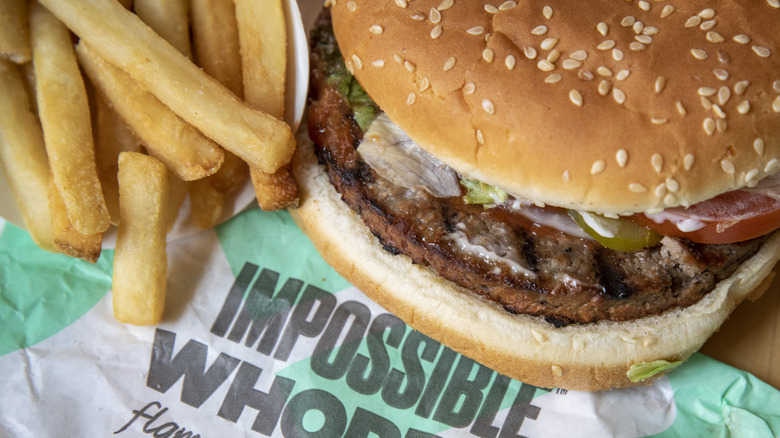
A host of different Whopper versions have been introduced since the birth of the sandwich. The Angry Whopper brought habanero cheese, smoked bacon, jalapeno slices, spicy onion petals, and something called Angry sauce into the mix. The Whopperito put a burrito spin on the sandwich, piling on Tex-Mex flavors and adding a creamy queso sauce. The Impossible Whopper introduced a meatless version, giving vegetarian eaters an entry point to enjoy the iconic burger (vegans, too, with some tweaks, like holding the mayo and cooking in a microwave or on a cleaned grill section to eliminate meat residue). The Whopper Jr. brought us a downsized version. In terms of the foundational burger, though, honestly, not much has changed since 1957.
The original Whopper included a quarter-pound of beef (the chain touted it as "government-inspected" beef), which was broiled over an open flame. It was topped with lettuce, tomatoes, pickles, onions, ketchup, and mayonnaise and served on a toasted bun, which the chain referred to as a "giant" bun but which, in those days, didn't have any sesame seeds on top. The modern version of the Whopper is largely the same: a quarter-pound of flame-grilled beef topped with tomatoes, lettuce, pickles, white onions, ketchup, and mayonnaise, with the sesame seed-specked bun sandwiching things together.
Burger King's "have it your way" mantra has enabled diners to customize their Whoppers in ways unheard of in the 1950s. The chain states there are over 200,000 possible customizations for the sandwich, ranging from adding extra toppings like bacon and jalapeños to going bun-less, having your sammie cut in half, or extra patties.