

How Meat Was Kept Fresh Before Modern Fridges

With the convenience of the modern fridge, we rarely think twice about how to store our meat. But when disaster strikes and the power goes out, meat is usually the first thing to spoil. Refrigeration is actually a relatively recent invention, only becoming the norm in the early 20th century. So what did people do before that? They didn't simply rush to eat their meat before it spoiled. Instead of relying on cold, people relied on alternative preservation methods, including smoking — an age-old method that's still widely practiced today.
The most common culprit behind food spoilage is water. Bacteria need moisture to thrive, so many early preservation methods focused on removing as much water from the meat as possible to extend its shelf life. Modern refrigeration takes a different approach, using cold temperatures to slow bacterial growth. Smoking meat, however, exposes meat to smoke from slowly burning wood over a long period of time. As the meat sits in the smoke, it gradually dries out while becoming coated in natural antimicrobial compounds found in the smoke itself. Together, these effects slow bacterial growth and help the meat last far longer without the need for a refrigerator.
Smoking alone isn't enough for long-term preservation
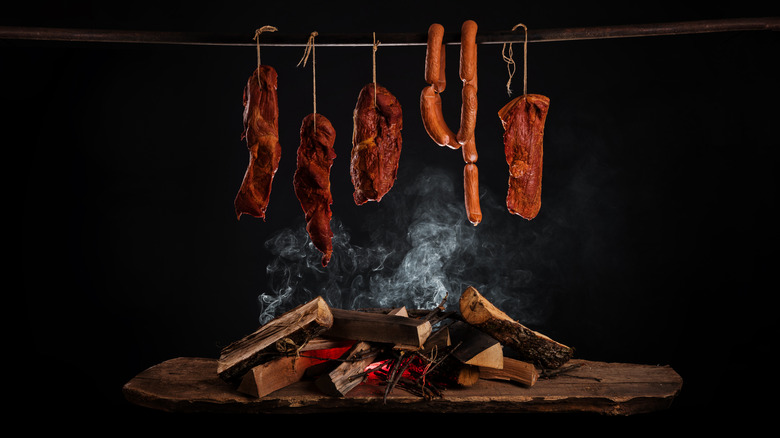
Smoking is a clever way to slow bacterial growth and extend the life of meat, but its effects are mostly limited to its surface. For true long-term preservation, smoking works best when combined with other traditional techniques, such as curing and drying. When these methods are used together, they create conditions that can keep the meat flavorful for months, or even years.
One of the oldest methods of preserving meat is curing, which is used for countless different types of meats. This technique works by adding salt or nitrates to meat, drawing out moisture and creative an environment hostile to bacterial growth. There are two different ways to cure meat: dry curing or wet curing. During dry curing, salt is rubbed directly onto the surface of the meat, whereas in wet curing the meat is submerged in a saltwater brine. Another traditional way to remove moisture from meat is drying. Historically, this was done by hanging meat in the open air or placing it under the hot sun. Today, the same effect can be achieved with controlled air-drying or by using an oven or dehydrator.
So where does smoking fit in? Typically, it comes after the meat has been cured or dried, adding an extra layer of preservation while also enriching its flavor. Thus is why its very common to find cured meats like bacon or ham sold with "smoked" varieties. It's also great for experimenting, as different woods produce different flavor profiles. Take hickory wood, for example, whose bold flavors are perfect for smoking pork butt and shoulder.