

The Bakery Display Case Red Flag That Should Send You Running
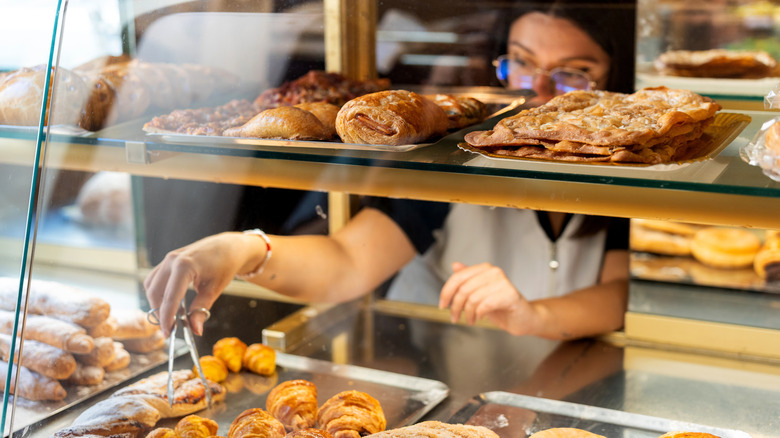
A trip to the bakery is a treat for the senses. Whether your jam is an apple cider donut or an ube cheesecake brownie, you can be confident you're buying a fresh, tasty pastry by watching for — and avoiding — some red flags at the display case.
For some expert tips on what to look for, Food Republic consulted professional baking expert, Beth Baumgartner. While various telltale signs can signal a baked good is less than fresh, Baumgartner relies on one key indicator in particular. "The biggest red flag I notice in a bakery display case is visible dryness," she shared. This is especially telling for items like frosted cakes, brownies, cheesecakes, and cut slices. "When something looks dried out, it almost always is," she advised.
Signs of overt dryness can include frosting that "looks dull or slightly cracked," edges of brownies appearing "hard or pulled away," or moister items like cheesecake slices looking "wrinkled and tired," Baumgartner detailed. Any of these qualities points to a treat that has been sitting out too long. "[Freshly] baked goods shouldn't look exhausted. They should look soft at the edges, smooth on top, and moist where they've been sliced," she explained.
Muffins are particularly prone to dryness once exposed to oxygen, and various visual cues point to staleness. "A good muffin should have a soft, slightly springy dome — not a wrinkled, shrunken top or a dry, pale crust that looks tough," Baumgartner said. "If the liner is pulling away significantly or the top looks dull and stiff instead of tender, that often means it's past its prime."
If the treats are dry, say goodbye

Prolonging freshness is crucial for a bakery. If you see dried-out goodies, head for fresher pastures, as the shop may not be using safe storage practices. "Dryness tells you a lot about what's happening behind the scenes," Beth Baumgartner said. "It can mean the product has been exposed to air too long, not rotated properly, or wasn't formulated well to begin with. Good bakeries are intentional about first-in, first-out systems and replacing items daily when needed."
Drying begins almost as soon as a baked treat leaves the oven, and moisture retention begins at the recipe level and extends to how baked goods are handled, including cooling methods, glazes and fillings, and packaging. Various techniques can keep items like sliced cake cuts moist, for instance, and the right recipe promotes moisture retention. "When something dries out quickly, it can signal shortcuts — either in ingredients or in testing," Baumgartner cautioned.
She added that there are some exceptions to the dryness test. "Rustic breads are meant to have a firm crust, and powdered sugar can sometimes look patchy after sitting in a case," she shared. "A little condensation on cheesecake in a refrigerated display isn't unusual either." For the rest, whether it's a cupcake, a brownie, or a bar, "visible dryness is usually a cue to pause," she warned. "A bakery that cares about quality protects its product and doesn't let it sit until it looks tired," she added. "If it doesn't look fresh, it probably isn't."