

General Tso's Vs Kung Pao Chicken: Here's The Actual Difference
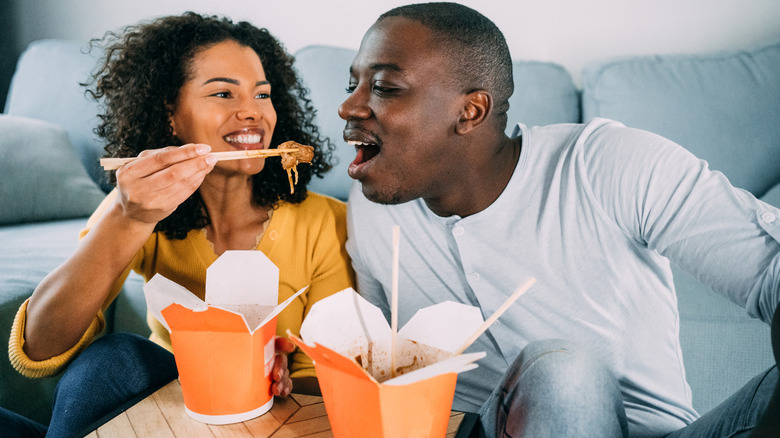
Scan a Chinese takeout menu, and poultry is nearly always available. While chicken is cleverly prepared into a myriad of preparations, General Tso's and kung pao stand out as two long-running favorites. Yet while it's easy to chalk up their distinction to a few tweaks in preparation, the two foods entail wide-ranging distinctions.
In terms of technique, General Tso's is a sauce-covered, deep-fried dish while kung pao is a stir-fry meal. The mode of preparation results in a completely different eating experience. While General Tso's is crunchy, tangy, and sweet, kung pao instead melds all five basic tastes, underlaid by a smoky edge. Not to mention that common ingredients between the two vary: Kung pao's essential peanuts don't appear in General Tso's, for example.
Even originating on different continents, such a multitude of nuances hints at the enormous range of Chinese cuisine, not to mention its evolutions overseas. So whichever rendition you choose to order or prepare, keep the two dishes' incredible complexity in mind.
General Tso's chicken is a deep-fried Chinese-American classic
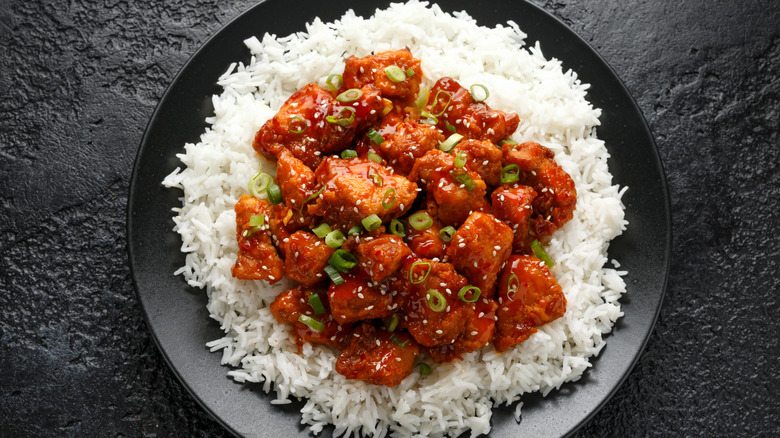
The name may reference a prominent 19th-century Chinese leader, but General Tso's chicken emerged completely outside of mainland China. The dish beloved today – crispy bites of battered chicken covered in a sweet-spicy sauce — is a thoroughly Chinese-American creation that only appeared in the 1970s. So while kung pao chicken is popular across China, General Tso's is heavily tailored to the American palate — even though the original dish, a salty-sour-hot concoction, was created in Taipei. The fried, sweet-sour coating we know likely came from chef Tsun Ting Wang in New York City.
Still, as two dishes from a wide-spanning Chinese diaspora, there are similarities between General Tso's and kung pao. Both rely on the aromatic base of garlic, ginger, scallion, and dried chile — although General Tso's typically comes in drastically less spicy. Furthermore, to create mouth-watering, tender bites of poultry, both dishes marinate the chicken using a variable based on Shaoxing wine and salt.
As common Chinese-American cuisine, the two dishes come in abundant variations. For General Tso's, the namesake poultry can be ground or large cubes as well as swapped for everything from shrimp to beef, or even a General Tso's cauliflower rendition. Furthermore, while crunchy, battered pieces of chicken form the bulk of the dish, many chefs work in vegetables like broccoli, bell peppers, or mushrooms alongside.
Finally, there's General Tso's defining thick sauce that envelopes every bite. Opposed to kung pao's soy sauce-heavy flavorings, this fried dish relies on rice wine vinegar, sugar, chicken stock, and soy sauce. Simmered down, it's a caramelized coating à la orange chicken sauce (a later adaptation of the dish). Sweet, crispy, and complex, the dish is a hallmark of Chinese-American cuisine.
Spicy kung pao is a stir-fried chicken dish
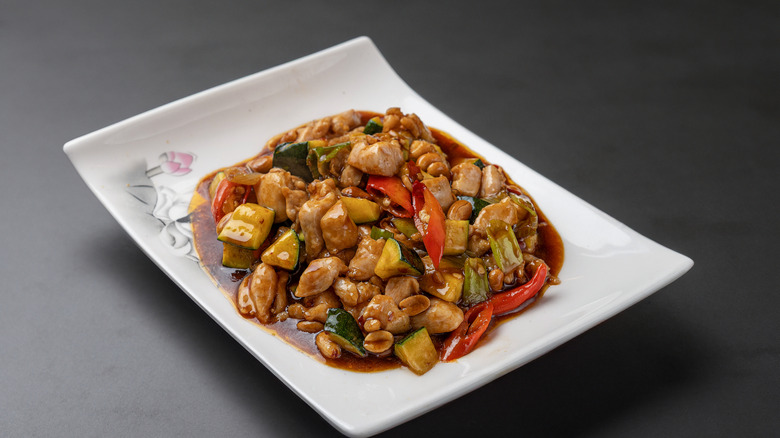
The delectable merits of kung pao chicken span many cuisines. Abundant regional versions exist within China, and there's a sea of Chinese-American renditions, too. All bound together by the medley of tender chicken, dried chiles, and peanuts, it's a quick-to-assemble yet complex-tasting creation.
Fundamental to all versions — and a noted distinction from General Tso's — is preparation in a wok. The pan is used to saute the aromatics, quickly sear the chicken, and meld everything together with the sauce, all while imparting a dash of wok hei. The dish comes out sizzling hot in both temperature and often spice, immediately warming the soul.
Unlike General Tso's, a kung pao chicken recipe is not sweet, with the seasoning favoring salty-savory notes, largely by way of soy sauce. Long, dried red Chinese chiles dependably appear — in greater quantities in Sichuanese versions — alongside a dash of the citrusy, mouth-numbing Sichuan peppercorns. In Chinese cuisine, texture plays a prominent role, and kung pao satisfies such criteria via the peanut's crunch matched with the chicken's softness.
Such a trifecta of texture, spice, and sauce applies to a dizzying range of proteins — the lack of a batter expands even past General Tso's. You can make the dish using everything from shrimp to mushrooms, peas, pork, or tofu, thereby accommodating a wide array of diets. Alongside, vegetables are welcome, with bell pepper and celery common in takeout-style renditions while cucumbers are popular in China. It's an always shifting composition that's dependably satisfying.