

Taverns Vs Bars: The Difference You Need To Know Before Your First Sip
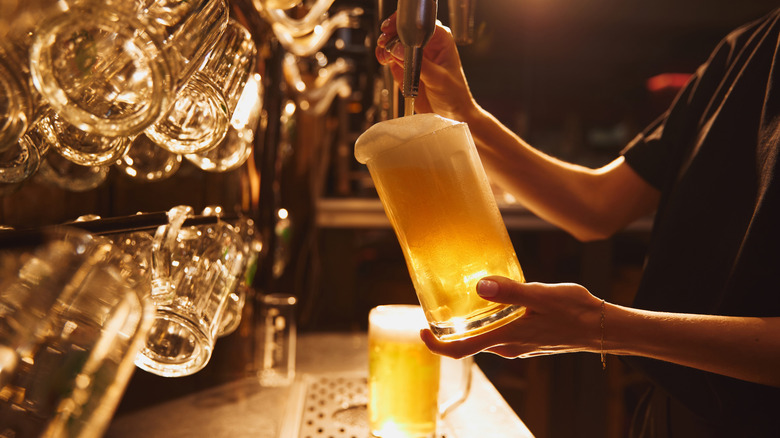
Places to revel come in many forms, with each business type delivering a unique experience. Step into a tavern, for example, and the typical ambience differs from other bars. Sure, you'll find a selection of wine, spirits, and beer taps, a friendly bartender, and often a cast of regulars. Yet in the decor, service, and menu, such spaces create a distinct atmosphere.
Namely, taverns blend in more restaurant-like elements, with a full food menu and a space full of tables, all in cozy wood-clad furnishings. Deep-rooted in both British and American culture, such businesses intertwine the community through tasty drinks and reliable offerings like burgers, steaks, fish and chips, and pies. Some might offer unique regional favorites, while others entice with fusion-inspired or modernized menus. Largely, the appeal distills to a cozy yet elegant ambience — think a roast, a brew, and a fireplace.
Taverns occupy a blurry line between restaurant and bar, reminiscent of a gastropub. When a pint is in hand and the conversation is flowing, the atmosphere is certainly bar-like. Yet, once plates of food hit the spacious table, the scruffiness of a dive bar feels a world away. It's a pleasant combination upheld by centuries of tradition — a history that defines the tavern's unique status.
Taverns trace back centuries, serving food and drinks

Humans have imbibed and dined for millennia, with the first beer-serving spaces tracing back over 4,000 years to Mesopotamia. As the concept evolved into Ancient Roman and Greek civilizations, early places to convene for alcohol often offered a tavern-like experience, with food accompanying the drinks. Many of these early locations also housed guests, establishing the close link between inn and tavern that continued for centuries.
Such casual establishments proved especially popular in the British Isles, where taverns proliferated as casual, convivial establishments with offerings at accessible prices. Carried over by Europeans, their prominence transferred into colonial America, where such spaces functioned as buzzy social hubs, often playing pivotal roles in the community and government. The oldest bar in the United States started as a tavern, along with many other historic watering holes.
As the U.S. grew in size, taverns took on new connotations – East Coast versions became known for heavy drinking — while Midwestern taverns functioned similarly to restaurants. Further shaped by Prohibition, industrialization, and new bar types (like the cocktail movement), taverns have since faded from their once ubiquitous nature. Still, many remain in operation as bustling neighborhood bars. No longer housing travelers or serving as critical political meeting points, taverns instead function as cherished capsules of time, often with historic decor and comforting food options. Defined by comfort, casualness, and elegance, they're a type of drinking den with long-lasting appeal.
Bars serve many contexts but typically only serve drinks (and maybe nuts or chips)
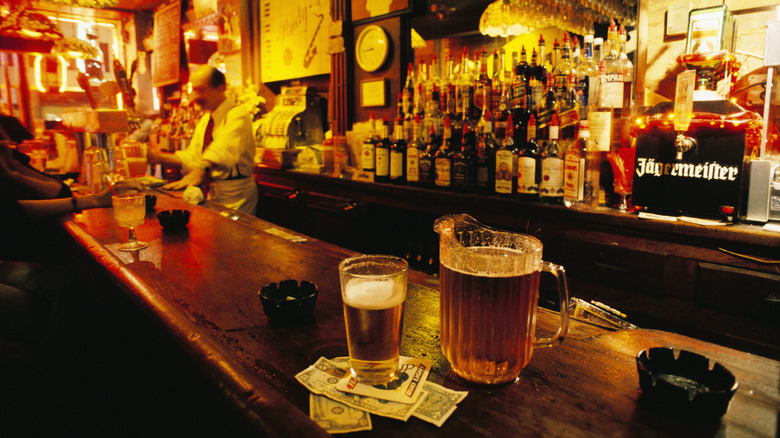
Walk into a bar, and only one thing is certain: Drinks are the focus. A hugely comprehensive business category, the U.S. alone is home to more than 70,000 such nightlife outlets. All bars share qualities — like a liquor license (at least per U.S. law), traditionally evening operating hours, and an atmosphere dedicated to revelry. Yet nowadays, even the serving of alcohol is no longer a foundational feature, with quickly expanding mocktail bar concepts.
Still, either the served drink or the context of consumption prompts categorization, a distinction between many bars and food-focused taverns. Sift through popular beverage options – wine, craft beer, spirits, cocktails — and each comes with a dedicated consumption space. Some bars push the envelope of beverage flavor and texture, all while adapting to Gen Z's drinking habits. Others serve as a hub for arts or sports, with drinks a vessel for other interests.
Furthermore, bar spaces occupy diverse cultural contexts. Upheld by global influences, atmospheres range from a cozy Irish pub to the retro origins of a Tiki bar, or a bustling izakaya (a casual Japanese drinking establishment). Among such businesses, taverns stand as a centuries-old European and American concept. A storied option amongst an ever-changing crowd, they ultimately serve the same bar function: a place to socialize, unwind, and connect.