

The Old School Egg Tool That No One Uses Anymore
We may receive a commission on purchases made from links.
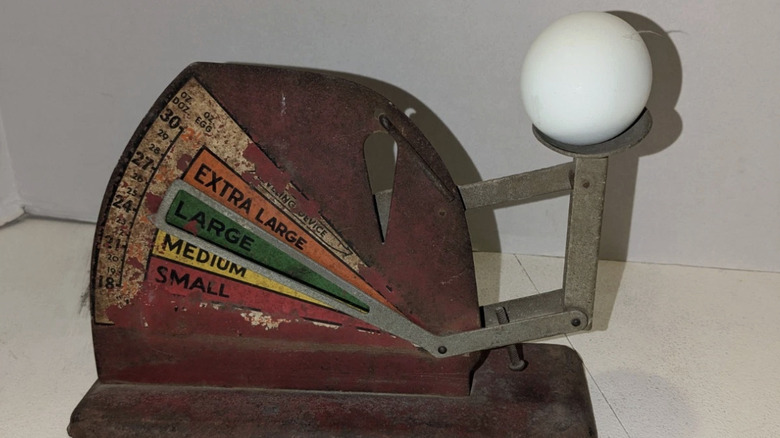
While many old-school kitchen tools still hold up today, some gadgets haven't stood the test of time. One such curious example of outdated technology is the egg grader. Essentially an egg-designated scale, it offers a small groove for nestling the food, which connects to a sliding weight indicator that then delineates the egg into categories like small, medium, large, extra large, and occasionally jumbo.
Some models feature a built-in light for inspecting internal blemishes, while others — like this one by Kuhl — extrapolate a single egg's weight into a dozen. Also called an egg scale, the tool is often charmingly decorated, perhaps resembling a hen or simply featuring colorful decals.
Such egg graders date back as far as the 1920s, most prominently produced by the Jiffy-Way brand. Once widely employed by both poultry farms and independent chicken owners, egg graders were even custom-made for clients, lending them a collectible-like status. Although now largely obsolete, they're the quirky kind of tool you'd come across at a flea market or resale website.
Why egg scales faded from popularity
Egg scales achieved peak usage in the first half of the 20th century, often utilized in domestic settings by small-scale poultry farmers. Whenever a hen laid an excess of eggs, farmers would use the tool to categorize the food, then sell it by advertised weight at local markets. Furthermore, the U.S. government purchased an abundance of eggs from small-scale producers during both World Wars, adding to the device's proliferation.
In fact, the U.S. didn't introduce federal egg inspection until 1946, with the passage of the Agricultural Marketing Act. For decades, such examination remained completely voluntary, until the passage of the Egg Products Inspection Act in 1970. Nowadays, cartons of the indispensable morning food come delineated by the USDA into three classifications: AA, A, and B, making the need for any do-it-yourself egg grading obsolete (unless you're a small-scale chicken farmer).
Yet what makes grade AA eggs so much better than grade A isn't about size at all. Instead, inspectors look for culinary characteristics, such as the firmness of egg whites, visual qualities of yolks, and shell quality. The USDA does accompany such categorization with regulated weight metrics, ranging from peewee to jumbo, helping you note what size eggs to use. Yet no longer does a simple old-school tool dictate egg sales; more complex attributes are now involved.