

How Jack Daniel's Paved Its Own Path To Claim Tennessee Whiskey
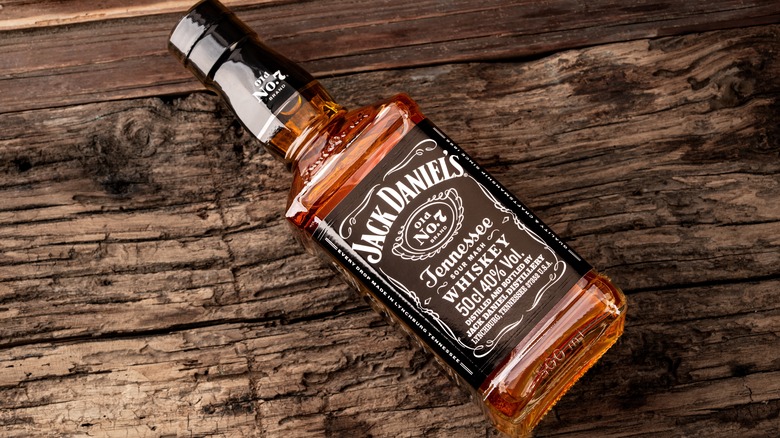
Jack Daniel's, one of the world's top-selling liquor brands, distinguishes itself through various means, ranging from its distinct square whiskey bottles and storied, eye-catching labeling to a special classification of its spirit. The distillery contentiously lobbied its state government, passing a 2013 measure that created Tennessee whiskey as an official style.
Enforced by Tennessee state authorities, the regulation requires Tennessee whiskey to meet the same legal standards as bourbon: It must employ a minimum 51% corn mash bill and age in exclusively new, charred oak barrels. In addition to production exclusively within the state, the style's central distinction is a requirement long employed by Jack Daniel's: the use of charcoal filtration
Also called the Lincoln County process, this added technique drips the whiskey through charcoal derived from sugar maple trees. The step serves as added purification, mellowing the whiskey's flavor palate and accentuating sweet, smooth notes. Although a respected Tennessee tradition, Jack Daniel's push for formal legislation stirred controversy. Following the law's passage, all bottles labeled Tennessee whiskey require at least minimal charcoal purification — a mandate that could read as exclusionary. Some bourbon distillers believe the technique strips away the spirit's nuance, while other producers may not involve charcoal in their tradition. Nevertheless, the initiative has lasted for well over a decade, helping promote a unique regional whiskey style.
Jack Daniel's lobbied for regulation of a historic whiskey style
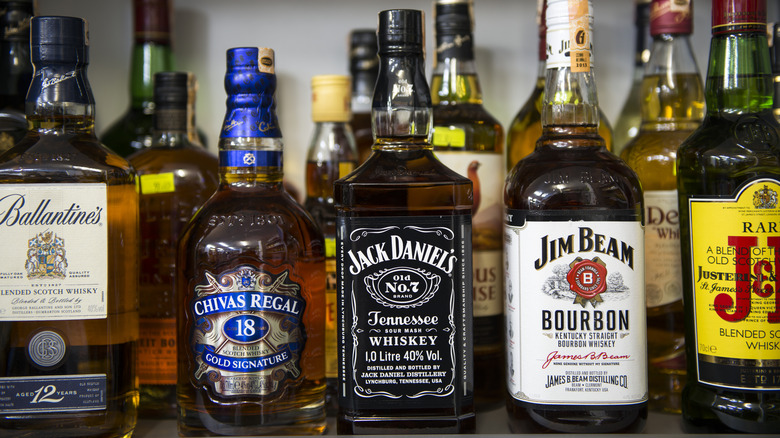
Whiskey comes in a wondrously wide-ranging assortment of styles, with small shifts in technique and ingredients reflected in distinct flavors. Legislation aside, Tennessee whiskey upholds this spirit of diversity. Curiously, Irish monks are to thank for Tennessee whiskey, having formed the liquor's base using Irish distillation techniques. The charcoal filtration process dates back to the early 19th century, originating prior to the founding of Jack Daniel's in 1866.
Today, many whiskey brands employ charcoal filtration, continuing a historic tradition through a myriad of interpretations. Jack Daniel's process entails an extensive 10-day purification period, while others utilize only minutes of contact. As a cherished part of the state's identity, few oppose charcoal filtration itself. Instead, the question is whether regulation is necessary.
Following Jack Daniel's lobbying, Tennessee whiskey regulation does not outline charcoal filtration specifics. Theoretically, even the briefest contact qualifies the spirit, meaning the label does not reflect quality. Coupled with Jack Daniel's extensive charcoal setup prior to regulation, this opened the door to backlash among some distillers. Historically, the technique is known as the Lincoln County process, but Jack Daniel's is located in a neighboring county — so why should statewide producers abide? Some defend the legislation as a preservation of heritage. Tennessee whiskey's flavor differs from Irish whiskey and other styles. A state-enforced label helps promote its unique composition, letting consumers know it is a whiskey unlike the rest.