

How Red Beans And Rice Became A Monday Tradition In Louisiana
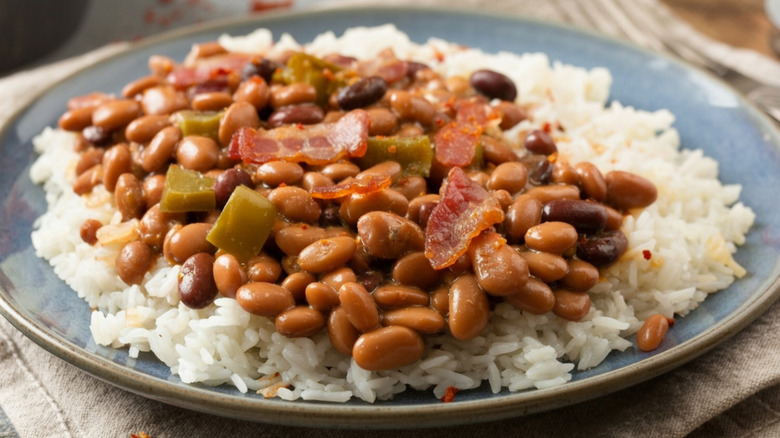
For a taste of New Orleans' unique Creole gastronomy, it's hard to go wrong with red beans and rice. Upon first glance, the dish looks like a straightforward side — a hearty bowl of legumes accompanied by a grain. Yet the classic combo not only packs a mouth-watering, complex flavor, but it comes with a rich culinary heritage.
To this day, the meal is a cherished Monday tradition in Louisiana, especially in New Orleans. You'll find the dish as a daily special at Creole restaurants and bubbling away at home, ready to start the week on a satisfying note. The practice started due to Monday's historic status as a laundry day, which necessitated easier cooking for homemakers. A pot of beans fit perfectly for the task, especially since the dish employed a wash day appliance.
Originally, water for clothes-washing was heated in a pot over a coal-fired furnace. Once the water boiled, the beans could be placed into the hot vessel and left to cook unattended, bubbling away to a thick and creamy consistency. This allowed for all hands on deck to go toward washing, but just because it was easy doesn't mean it wasn't (and isn't) delicious. Cured meats — like local favorite spiced andouille, smoky Tasso, or tangy pickled pork shoulder — flavored the dish and were usually leftovers from Sunday meals. Furthermore, many renditions infused Cajun aromatics into the foundation, like celery, pepper, and onion, as well as different Creole or Cajun spices. Finally, rice — long a pantry staple in Louisiana — was ready to sop up the beans' gravy. Together, such a mixture of readily available components yielded an aromatic, satiating, yet hands-off protein-forward dish.
Red beans and rice intertwine Creole's many culinary influences
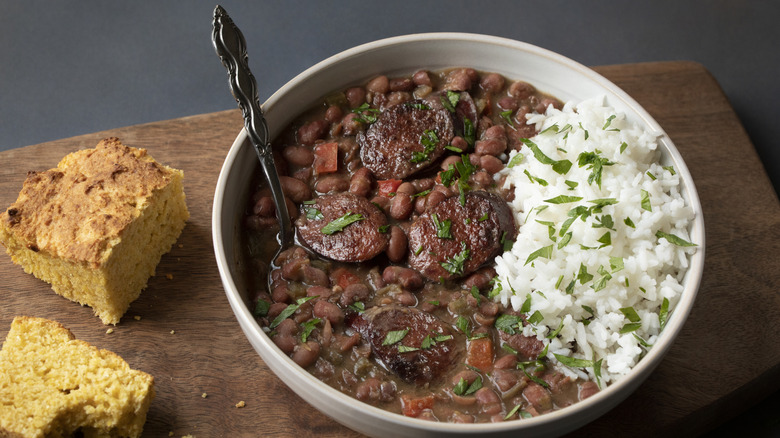
No two red beans and rice recipes are precisely the same, a showcase of Creole cuisine's rich history. So, to understand the dish's continued prominence — as well as its cherished Monday tradition — it's helpful to dive into the food's complex history. Historians suggest the template for the pairing appeared in Creole cuisine during Spanish colonization, carried over from Haiti, where a similar food continues to be a modern staple.
The components in red beans and rice represent the many cultures that intersected in Louisiana. Dried beans were already consumed in local Native American cuisine, while the process of slow-cooking beans arrived alongside enslaved West Africans, who also brought valuable rice cultivation techniques to the region. Later, French settlers introduced the Cajun Holy Trinity (celery, onion, pepper) aromatic base, which is also utilized in local dishes like Louisiana shrimp étouffée. Europeans also popularized sausages in Louisiana, filling out the flavorful composition of red beans and rice.
Affordable, flavorful, and nutritious, the dish remained popular for centuries. Its pragmatic nature paid off during eras like the Great Depression, and never lost relevance into modern times. Today, digging into a pot of red beans and rice on Monday serves not only as an ode to laundry day, but the region's storied culinary legacy.