

This Rare Honey That Tastes Like Cotton Candy Is Only Produced In 2 US Regions
We may receive a commission on purchases made from links.
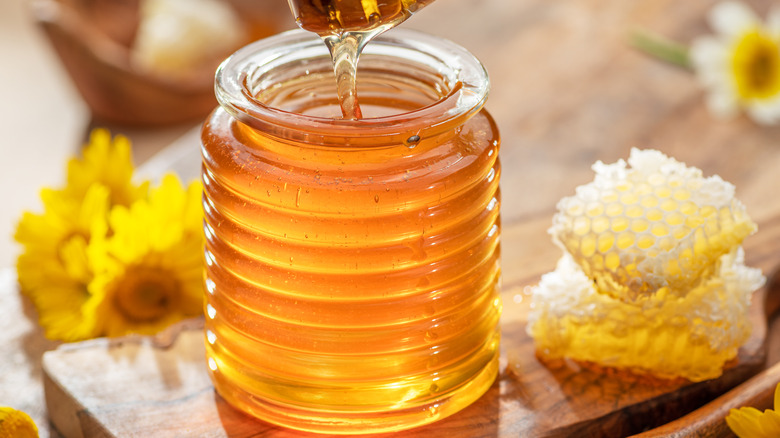
Most often, honey is thought of as an indispensable, never-spoiling pantry staple. Sure, you might think of new creative ways to cook with honey or perhaps investigate the difference between light and dark varieties, but it's not the kind of foodstuff that draws gourmet intrigue. Yet, just like wine or varying types of coffee beans, honey exhibits complex terroir.
The foodstuff naturally comes from bees, which collect pollen from certain plants in a specific area. Such harvest — combined with specific year-to-year climatic factors — produces an enormous range of region-specific honeys, each of which comes with a unique flavor palate. The U.S. alone is home to some 300 varieties, with tupelo honey considered one of the rarest.
The sweet syrup intrigues with a special flavor — think delicate notes of cotton candy, gentle floral undertones, and subtle hints of spice, all smoothened into a buttery mouthfeel. Since the constituent pollen comes from tupelo trees specifically, this honey variety also exhibits subtle green tones. And to further its mystical allure, the foodstuff doesn't crystallize quickly, since it contains a higher fructose concentration than other honey types. Only produced in two small wetland regions on the Georgia and Florida border, the sweetener's understandably coveted.
Tupelo honey comes from a low-yielding production process
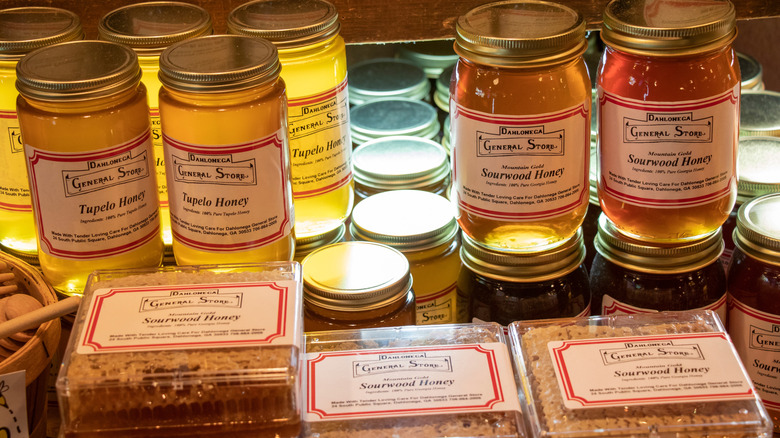
Tupelo honey emerged from intriguing origins, and it needs highly specific conditions for production. To make the foodstuff, bees must collect pollen from Nyssa ogeche and Ogeechee tupelo trees, which only grow in wetland ecosystems. While the plant's habitat stretches across the Southeast U.S., tupelo honey production is exclusively limited to two areas in Georgia and Florida's Southern Cypress Swamp.
Furthermore, Tupelo trees only blossom for a handful of weeks, with rain halting honey production — some years record no harvest. Subsequently, to optimize honey creation, the bee hives must be placed in precise locations directly in wetlands, with hives positioned on platforms, floats, or even barges. Both labor-consuming and low-yielding, it's understandable that the resulting product costs extra. A 16-ounce bottle of tupelo honey often nears a $30 price tag, opposed to a common variety under $10. Still, it's a worthwhile exchange to sample one of America's most unique products. So buy tupelo for a special Rosh Hashanah honey tasting flight or to drizzle on day-to-day; it's a sweet foodstuff worth the intrigue.