

How To Cut An Orange To Avoid Pith Every Time
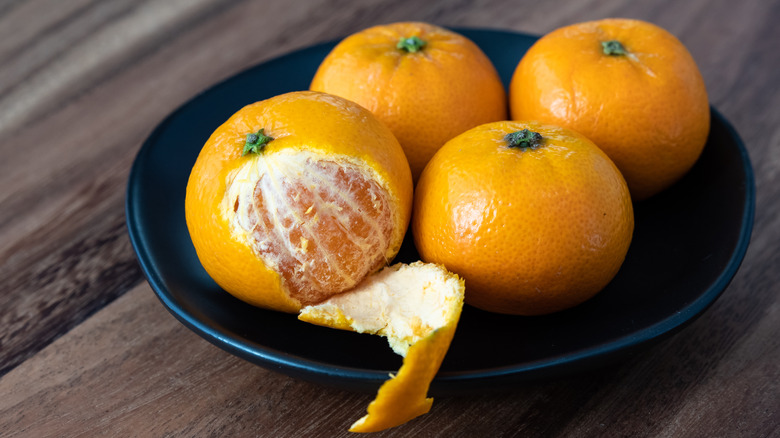
While perfectly safe to eat, the pith of an orange is bitter and denser than the flesh, creating an unwelcome texture. Even if you're just juicing your fruit rather than gobbling it up, it may gum up or simply present another solid you'll have to strain. Fortunately, avoiding the pith is quite easy — all you have to do is cut the fruit differently than you may be used to.
Place your orange stem-side up on a cutting board. Set your knife just off to the side of the stem and slice downward. Repeat this step three more times until you're left with a rectangular core of fruit, pith, and peel. This core piece is perfectly fine to eat, but note that it contains the majority of the bitter, internal pith you're attempting to avoid.
What you are left with are four clean, curved pieces of oranges. While these pieces still have pith between the flesh and the peel, you can easily avoid it by eating the fruit directly out of the peel. While this method is quite easy for consuming your fruit as is, there are plenty of others that are great for when you want to cook with or serve delicate segments with no peel or pith at all.
How to cut an orange to avoid pith and peel
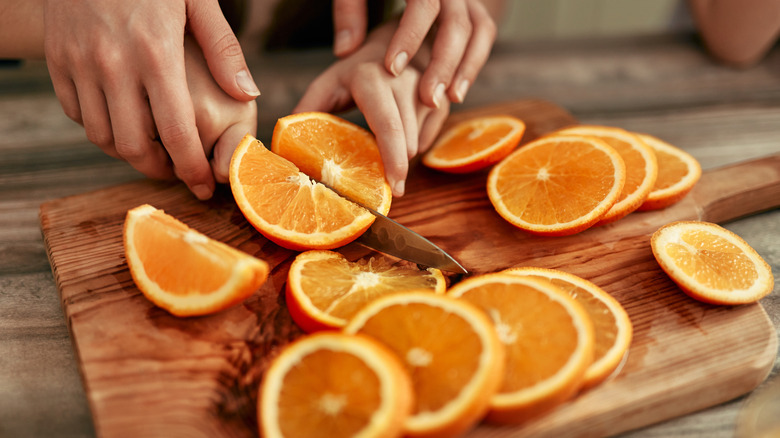
Like many great cooking techniques, the French derived a perfect way to separate fruit flesh from pith and peel ages ago, called supreme. Cutting fruit into tender, juicy supremes may take more effort, but it's the best option for cooking with, preserving, or serving the best-looking slices.
Slice off the first couple centimeters from the top and bottom of your orange so it lays flat. Take your knife and run it from top to bottom, removing the pith and peel as if you were removing the rind from a watermelon or pineapple. At this stage, it's better to slice off a little flesh than to risk leaving any pith behind. Once you've peeled your fruit, find where the segments connect and slice inward, at an angle, toward the center to remove them.
Ina Garten's technique for pith-free segments uses a serrated knife, which is great for getting the most out of any back-and-forth motion while peeling and cutting. However, you may find a paring knife easier to work with since it's so small. It's typically ideal for cutting fruit, as it's easy to maneuver and work around seeds, peels, and delicate segments. This is delicate work, so if you don't have either knife on hand, pick the sharpest one you do have to avoid ripping the flesh, squeezing the fruit, or needing to make more movements, slices, and sawing than absolutely necessary.