

Here's How To Grow Ginger In Your Kitchen
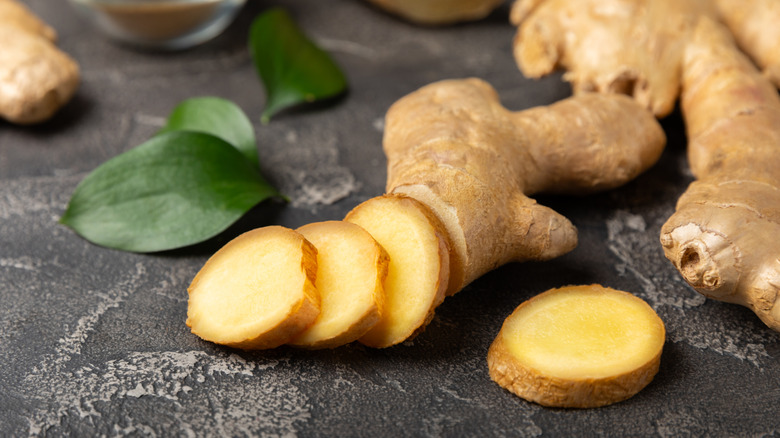
Fresh ginger is unbeatable — and it doesn't get any fresher than when it's grown right in your own kitchen. Just like growing a vegetable garden in egg cartons, Michael Clarke, landscape architect, horticulturalist, and founder of Yardwork, says that cultivating ginger indoors is surprisingly easy.
Clarke recommends selecting a piece of ginger at the store that has multiple "eyes," or dormant buds ready to sprout. "Cut it into sections, each with at least one bud, and let the cut surface dry overnight to help prevent rot," he says. "Plant the pieces shallowly, buds facing up, in a wide pot filled with loose, rich, well-draining potting mix." Shallow planting with the buds facing upward allows the tender new shoots to breach the surface with minimal effort. Because ginger is a tropical plant, it's important to keep the soil moist with occasional mistings and maintain a temperature between 65 and 80 degrees Fahrenheit.
With good-quality potting soil and some moisture-retaining compost, you'll create a cozy little environment for your plant to thrive. Ginger also prefers indirect light — typically from an east- or north-facing window — so there's no need to find a sunny spot. Since ginger is a root vegetable, it needs room to grow, so opt for a fat-bottomed pot or even a teapot-style indoor planter. Don't worry about not being able to see the roots — ginger offers plenty of visual cues when it's ready to harvest.
How to tell when ginger is ready to harvest
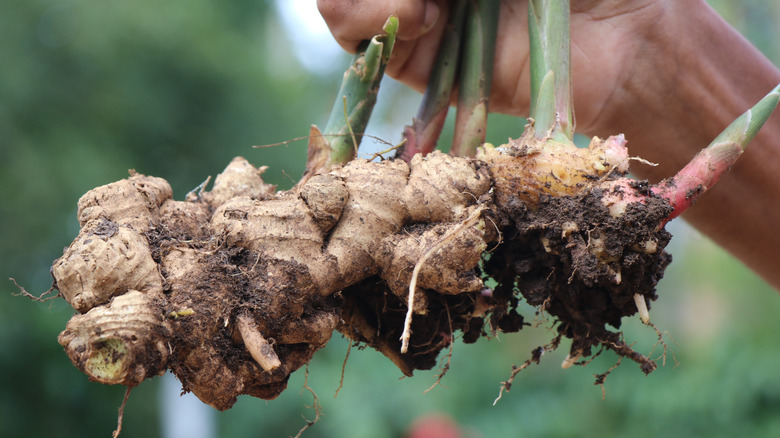
Juvenile ginger roots are still good, but taste a bit different than mature ones. They're often milder in flavor and lack much of the mature variety's sharpness. While Michael Clarke assures us you can harvest ginger at around five months, it's best to wait eight or 10, when all the indicators of maturation are present.
"When ready, the stems and leaves begin to yellow and die back naturally and its soil line may show swollen rhizomes pushing outward," says Clarke. "The pot will also feel heavier from rhizome growth." Blooms are typically what a plant works its whole life to create and are a great indicator that it's reaching the end of its lifecycle. While edible varieties of ginger don't bloom as aggressively, or as long, as ornamental varieties, dying blooms and yellowing leaves are signs that the roots have fully developed and are at peak flavor.
Still, dying foliage doesn't mean the roots are quite done. They'll continue growing and produce new shoots if you let it, so Clarke recommends only taking what you need and "[replanting] the rest to allow it to continue growing." Fresh ginger should be fairly tender, so feel free to scoop off what you need with the same spoon you peel the roots with, to create fewer dishes and keep your plant as maintenance-free as possible.