

The Simple Difference Between City And Country Hams

Ham — a meat variety that is so commonplace, it's easy to forget the intricacy. Always sourced from a pig's hind leg, everything from prosciutto to speck and holiday ham falls under the umbrella. Available as either a fresh or cured meat, American ham-makers delineate the latter into either a city or country style. The core difference between the two types is simple, essentially coming down to the use of a wet or dry brine. Yet the single processing step ties in with radically different ham-making traditions, which result in distinct flavor and texture.
Country ham is a centuries-old preservation process, extending the shelf life of pork without the need for refrigeration. Intact pork legs are covered in a dry salt and sodium nitrate-based rub, then aged for up to a year. Factors like the curing ingredients, optional smoking step, aging climate, and duration all translate into a complex array of flavors, which reflect the producer's artistry.
Meanwhile, city ham accelerates and standardizes the curing process to only several days, by way of a wet salt-based brine. Curing liquid is either injected into pork or submerges the meat completely, thereby rapidly infusing into the meat's core. The pork is then optionally smoked or cooked, although it nearly always requires refrigeration. Such a fast and easily industrialized curing process has established city ham as America's go-to style, with many varieties found on grocery shelves.
Widespread city ham is made using a convenient wet-brine

Opposed to country ham's historical roots, city ham is a newer culinary development, seeing as this cured pork style requires refrigeration. Ice boxes first emerged in American homes during the mid-19th century, and refrigerators around the 1920s. Not by chance, city ham picked up steam during the 1930s – before eventually becoming the most widely-made American cured pork later in the 20th century.
Since city ham employs a liquid rather than dry-rub curing process, a variety of pork leg cuts can be turned into city ham. There's spiral-cut ham, which is cooked after curing, as well as bone-in and boneless hams, which occasionally come raw. City ham is also frequently smoked, then sliced at the deli, making it a common candidate for sandwiches.
The flavor usually leans salty, although less so than country ham. The meat turns out pink-colored and dependably moist, with the brine ingredients as well as an optional glaze further influencing the palate. Such qualities make city ham easier to cook with than country ham. In addition to classic standalone dishes like holiday ham, it's used in soups, pastries, casseroles, and vegetable dishes. Its flavor mingles especially well with peas — hence the popularity of dishes like French peas or a ham and pea farfalle. In under a century, it's become a foundational part of the American diet.
Country ham is created using a complex salt curing process
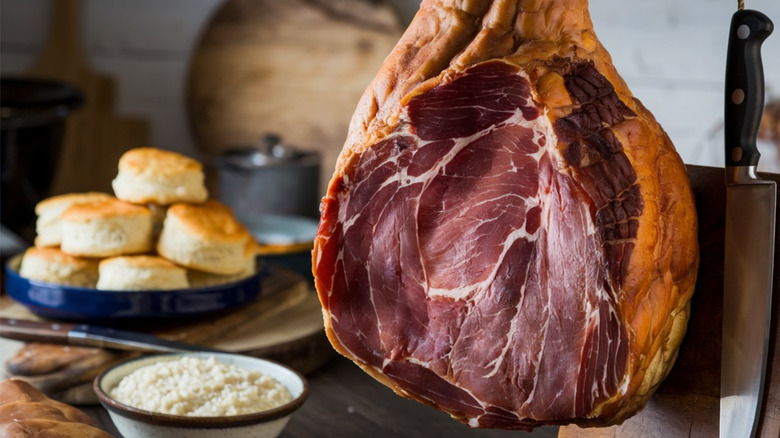
Country ham predates the birth of the U.S., with some of the earliest English settlers inventing the preparation style. Originally, such dry curing techniques emerged as a way to extend the shelf-life of pork, a widespread protein in many Southern colonies. Country pork eventually turned into a generations-old traditional practice, tied to a specific region called the "ham belt" — an area where aging conditions are favorable that spans the entire globe. Today, this region includes Virginia, North Carolina, Tennessee, and Kentucky, with many distinguished producers in each state — a regional affiliation that includes Spain's jamon iberico and Italy's prosciutto.
The country style is defined by its extended aging process, which ranges from at least a couple of months up to a year. Initial steps, like the rub, as well as optional cold-smoking, first set conditions, yet it is the months-long cellaring (traditionally conducted through the summer) that creates a unique dry-aged composition. The USDA requires a legal minimum 18% weight loss during this creation step, with all country ham federally inspected.
Although shelf-stable, country ham typically must be cooked (usually baked or boiled) before consumption, with only a few versions sold ready to eat. The cured pork type tastes dependably salty, accompanied by complex flavor notes that range from earthy to lightly funky, and oftentimes nutty. Like city ham, country ham's taste is also influenced by the initial rub and optional smoking. The texture comes dry — the meat's best enjoyed thinly sliced and savored in small quantities. Relished standalone, on a charcuterie board, or atop bread, it's a meat that shines among the world's most complex pork products.