

How Much Your Old Sterling Silverware Set Is Actually Worth

Once a hallmark of wealth and fine dining etiquette, sterling silver is becoming increasingly rare in everyday households. Much like the once-popular china cabinet, it's commonly found tucked away in grandma's house, valued for its decorative appeal rather than everyday use. If you happen to come across an old set of sterling silverware, there's a chance it could be worth a tidy sum. To find out how to assess its value, Food Republic spoke with antiques specialist Kayleigh Davies.
"Weight is key, as sterling silver has an intrinsic melt value, so even very plain or damaged pieces are worth their weight in silver," Davies told us. "Heavier is better." Sterling silver is usually 92.5% silver, with the other 7.5% often being made up of other invaluable metals like copper. So to find out the actual pure silver content of your set, weigh it and multiply by 0.925. It's also worth looking up the current spot price of silver, which fluctuates regularly in response to market supply and demand.
Beyond weight, make sure to assess the overall condition of a piece. Sterling silver is a soft metal, so it is prone to dents, scratches, and general wear-and-tear that "can affect value dramatically," Davies noted. For sparkling silverware, consider using aluminum foil to restore its shine. "Look out for engravings and monograms — these can push the value of an item down, but if it's a particularly interesting engraving or indicates a link to a noble family then the value can go up," she added.
Keep an eye out for hallmarks

As with many luxury goods, the brand and maker's name can significantly enhance the value of sterling silverware. "American names like Gorham and Tiffany & Co. can command strong prices ... particularly when it comes to iconic patterns like Gorham's Chantilly," Kayleigh Davies told us. "British pieces from the Georgian and Victorian eras can be valuable." In 2013, a George II sterling silver coffee pot made by renowned British silversmith Paul de Lamerie was sold at auction for an eye-watering $7 million.
Historically, a silver object is stamped with several hallmarks indicating its purity, the date of manufacture, and additional information. Another important hallmark to assess is the maker's mark. This stamp identifies the individual or company responsible for crafting the piece — for example, Paul de Lamerie's unique mark is the letters L and A surmounted by a crown with fleur-de-lis below. "It's worth [familiarizing] yourself with the marks of companies you like," Davies told us. "This will help you authenticate, and sometimes date, a piece."
While the United States does not require a hallmarking system, Davies explained that the majority of manufacturers voluntarily mark their jewelry with either the word "STERLING" or the numeric code "925." In contrast, "The U.K. has one of the strictest hallmarking systems in the [world] so British silver can be attractive to buyers — the lion passant, assay office mark, and date letter offer excellent traceability for collectors," Davies explained. In France, the lion passant is replaced by the goddess Minerva's head.
Sets, singles, and appraisals determine the value of silver
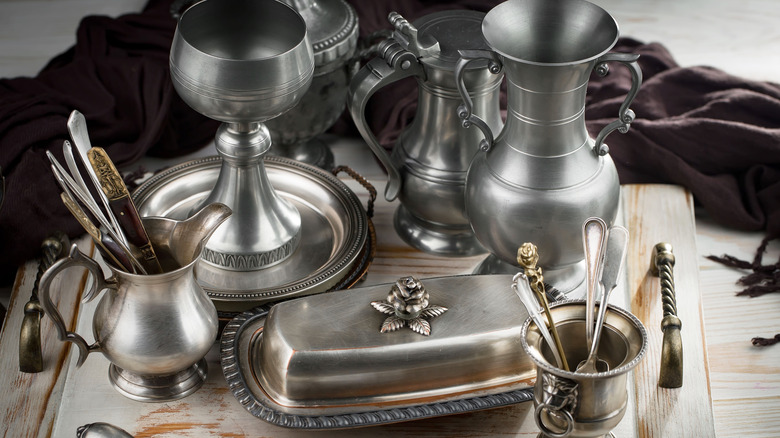
Sterling silverware comes in many forms. You can typically find full cutlery sets of flatware such as forks, knives, and spoons, as well as serving pieces like ladles, tongs, and platters. "A full matched set attracts a premium because people often want something ready to use for convenience," Kayleigh Davies told us. "However, single pieces can be valuable, particularly larger items like serving pieces." Aesthetic appeal and historical significance can also drive high prices for individual pieces. Many of the most expensive sterling silver items ever sold include single cups and tureens prized for their rich history and intricate craftsmanship. "Popular patterns can also sell well as single items as people look to accrue a full set, or replace worn pieces," Davies added.
For an accurate appraisal of your sterling silver, Davies advised against relying solely on online services, stressing that in-person appointments allow pieces to "be inspected with a loupe and ... weighed." The best person to approach also depends on what you are selling: For scrap-value items, a local or online dealer will usually suffice, while rare or antique pieces should be taken to an auction house (which "often see large volumes of items and can give ... current market valuations," Davies said) or a specialist dealer who can secure the highest price.