

Why The Origin Of Chimichangas Is So Complicated
In Southwestern cuisine, just a few ingredients convey remarkable regionality. Colorado's spicy green chili uses Pueblo-grown Mirasol peppers, while New Mexico's version reaches for Hatch. Alternatively, order tacos and receive a large and thin flour tortilla, as opposed to a crispy hard shell, and you're in Arizona rather than California. So, investigate the origins of a dish like a chimichanga, and the history holds many stories.
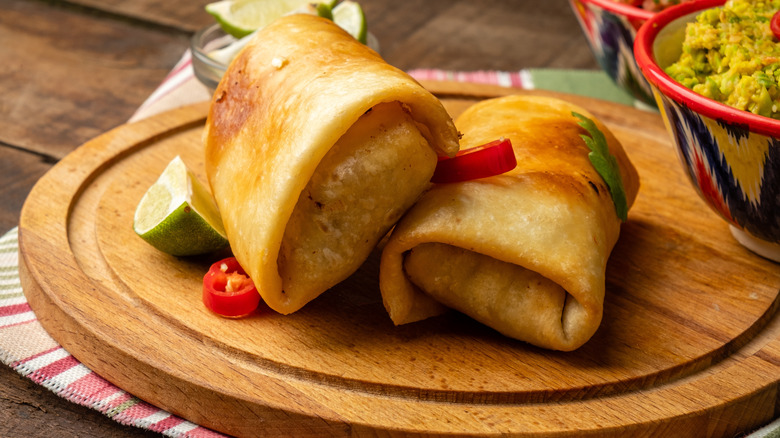
To those unfamiliar, a chimichanga consists of a burrito — filled with various types of meat and cheese, as well as rice and beans — that is deep-fried, mouth-wateringly crispy. Encased in a large flour tortilla, the dish comes out dense and flavorful, typically accompanied by condiments like sour cream, guacamole, and salsa.
Precisely who came up with the concept of deep-frying burritos is unknown, but the strongest roots trace to Tucson, Arizona. Commonly, people credit the founder of still-operating El Charro Café – America's oldest family-owned Mexican Restaurant. Allegedly, in 1922, owner Monica Flin mistakenly dropped a ground beef burrito into a pan of hot oil. A slight burn followed — eliciting an expletive that started with a ch. Yet, to not curse in front of children, Flin gracefully transformed the word into chimichanga, which is Spanish for thingamajig. The dish name stuck.
It's a colorful story widely circulated in Tucson, yet not without its skeptics. Woody Johnson of Phoenix, Arizona-based Macayo's Mexican Kitchen, also claims to have invented the dish with an accidental drop in the 1940s. Others cite that chimichangas emerged on either side of the U.S.-Mexico border by unnamed cooks, before achieving widespread popularity. Now enjoyed across the U.S, many stake a claim to chimichanga's origins, a testament to the dish's beloved quality.
More on chimichanga's deep ties with Tucson, Arizona
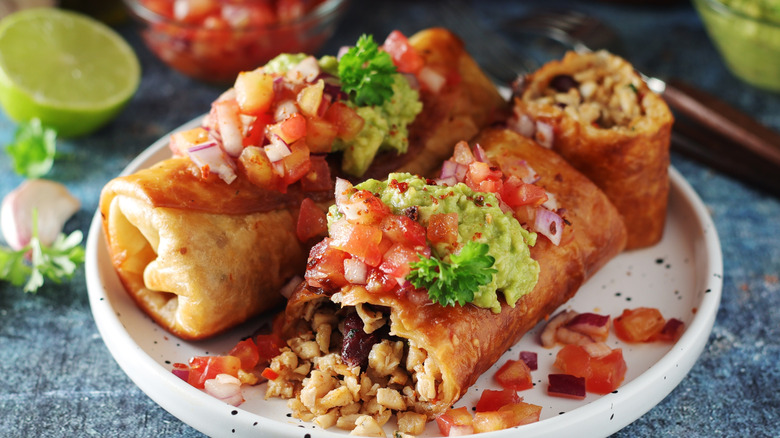
Regardless of the precise originator, chimichangas emerged in Sonoran cuisine. The culinary tradition, which is native to Southern Arizona and Northern Mexico, shares several elements with the dish. Most prominently, there's the foundational large tortilla; chimichangas rely on the large yet pliable Sonoran variety. Furthermore, machaca is the traditional chimichanga filling — a rehydrated, jerky-like meat originating from Mexico's side of the Sonoran state.
So, although the chimichanga is often defined as a Tex-Mex dish, the food's a staple of American-Sonoran cooking. Ties are especially strong with Tucson, Arizona, a city recognized by UNESCO as a Creative City of Gastronomy. Restaurants like El Charro Café and a breadth of family-run eateries uphold the century-long culinary tradition, serving thousands of chimichangas weekly. Recipes are passed down through generations, with devoted followings split between restaurants. Contentiously, some eateries pair the dish with a signature sauce, while others maintain the dish should be enjoyed with simple condiments.
A 2011 campaign — jointly started by rival originators El Charro Café and Macayo's Mexican Kitchen — even attempted to make the chimichanga Arizona's state food. While the ballot failed, the initiative reveals chimichanga's strong imprint; it's a cherished regional classic now consumed nationwide.