

Why Some Fast Food Restaurants Serve Items In A Basket
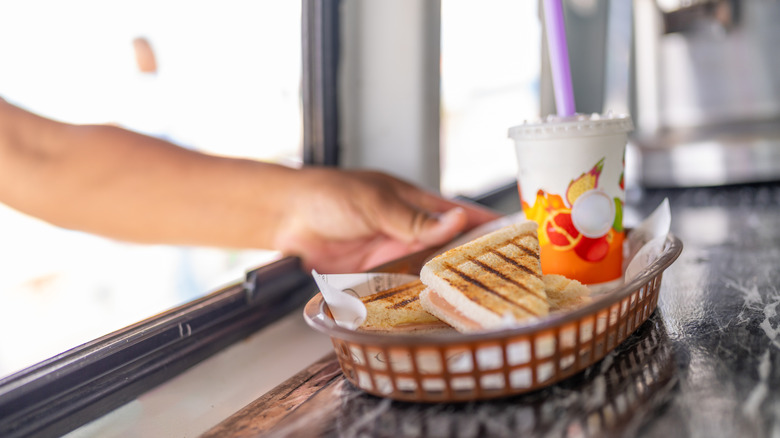
The major appeal of fast food lies in dependability and affordability. Subsequently, chains optimize their offerings in not only the food itself, but the way it's served, too. Packaging plays a critical, yet often overlooked, role in the fast food experience, with every type of vessel offering unique advantages. So when you swing by a chain, order some fries or chicken tenders, and receive the food in a basket, it's helpful to consider the motive for the meshed vessel.
Fast food restaurants turn a profit through maximizing efficiency and lowering costs, and the baskets achieve such motives with surprising success. Usually made from plastic, baskets are cost-effective, sturdier than paper or ceramics, and easy to clean. Unlike a plate or bowl, the container only requires a sanitizing rinse and a new liner — enabling quicker turnover and eliminating the need for rigorous dishwashing.
Furthermore, the shape of the basket itself comes with sneaky advantages. Opposed to often oversized foam containers – which are also detrimental to the environment — a basket's size enables easy portioning. Fast food chains make food quickly, then swiftly plop it all into the vessel, generating a meal that looks immediately appetizing. The portions appear a touch more generous, and colorful parchment paper sops up some grease, too. All by way of a simple plastic construction, a basket lends quite a range of advantages.
Baskets are well predisposed for casual dining concepts
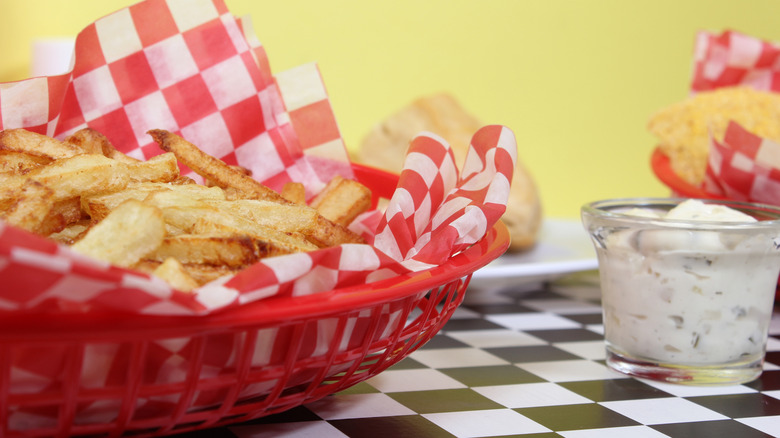
Today, baskets aren't universal in the world of fast food. You'll mostly find them at chains like A&W and Culver's (which also runs a meal deal called a value basket). Largely, it comes down to the fact that fast food chains heavily rely on disposable products, often blurring the lines between dine-in and takeout. So instead, baskets are more common in the fast-casual and diner niches. As one Redditor theorized, "Baskets are a holdover from when diners were a much larger part of the dining scene."
Baskets offer a distinct set of advantages for full-service restaurants and diners. In addition to their ease of reuse, baskets are easy to carry, enabling quicker meal delivery. They're light, won't fracture when dropped, and enable the easy discarding of food scraps — no need to scrape plates clean. The containers also readily stack on each other, further easing portability.
Not to mention, the serving vessel can even subtly enhance the dining experience. Opposed to more formal dinnerware, baskets signify casualness — think fried foods accompanied by brews. Restaurants might utilize fun, bright, and trademarked parchment paper atop a basket, invoking extra flair. There's an underlying touch of old-school appeal to the basket experience. So, when pondering the difference between fast food versus fast casual eating, think of the way baskets come into play.